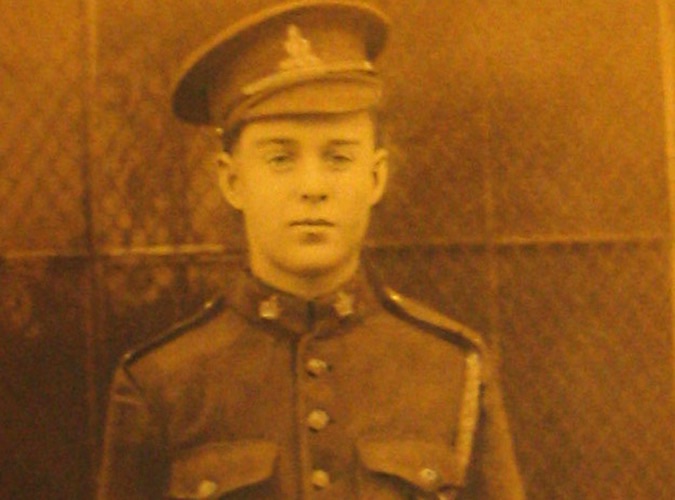

Google the question “Who was Canada’s youngest soldier in the First World War?” and you’ll find several names of 14- and 15-year-old boys who enlisted and went overseas.
But Google seems to have forgotten a local Hintonburg teen who strapped on his brother’s trousers, lied about his age, slipped past a recruitment officer eager to meet his quota, and ended up on the battlefield in France before his ruse was discovered and he was sent home.
George Dudley was one of Canada’s youngest soldiers — and may well have been Ottawa’s youngest. His story, from more than a century ago, is a fascinating one.
In the early days of the First World War, many teenagers felt a strong sense of duty to enlist, even if it meant lying about their age. It is estimated that between 15,000 and 20,000 underage Canadian kids enlisted using false birth dates to go overseas. This wasn’t an era of databases and ID cards. Whatever you wrote on your enlistment papers was often taken as fact.
Teenagers enlisted out of duty or patriotism. In some cases, it was to escape hard farm work — or no work at all. Others signed up for the adventure, a chance to see the world and visit places they might never otherwise have imagined.
The minimum enlistment age was initially 18. It was later raised to 20, and eventually lowered again to 19. As the war continued and casualties mounted, recruiters increasingly “turned a blind eye” to applicants who appeared much younger. After only a short period of training, it could be a matter of months before a new recruit was sent overseas. (In fact, until the fall of 1915, even men of age were required to have parental consent, and married men needed to prove they had their wife’s approval.)
Some parents had no idea their teenage children had enlisted. They simply disappeared. Others later learned through newspaper reports or word from friends and relatives that their child was overseas and taking part in major battles on the front lines. Mothers contacted military authorities demanding their return. Some boys were sent home — only to run away and re-enlist. A few even made it overseas a third time.
A Hintonburg boy goes to war
At the recruiting office in the Russell House hotel at the corner of Sparks and Elgin streets on Sept. 28, 1915, 14-year-old George Dudley walked in and approached the duty recruitment officer. Standing just four feet six inches tall, weighing 126 pounds and wearing short pants, he could hardly have looked his 14 years.
“The officer in charge told me to go home and feed up a little before I could join,” Dudley later recalled in an interview.
But Dudley had another idea.
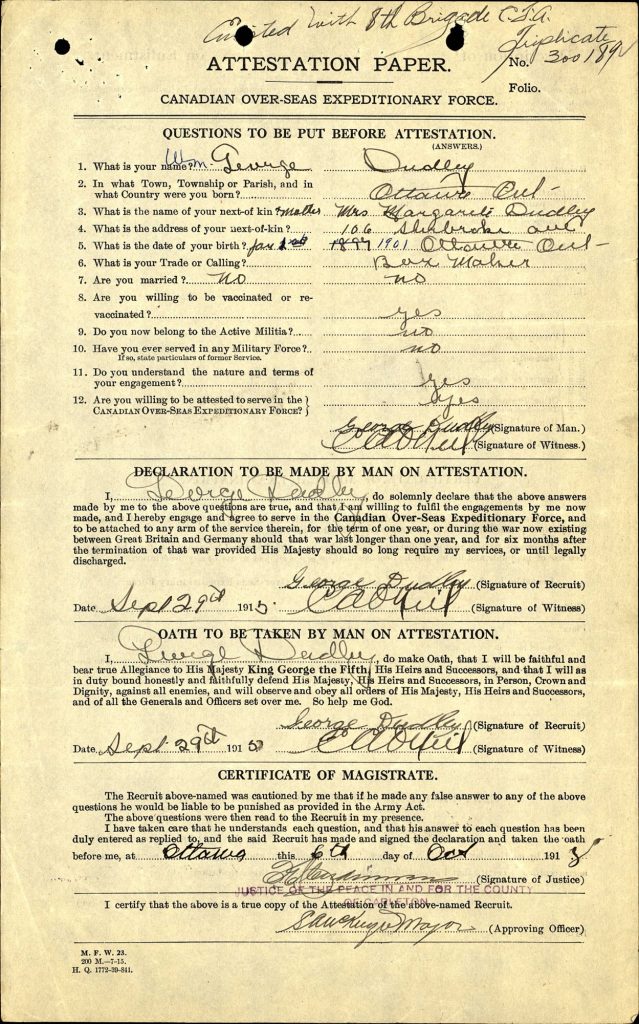
Undaunted, he returned home to 106 Sherbrooke Ave. in Hintonburg and asked his parents to sign a note of approval. They eventually relented, not believing the recruiting officer would accept him anyway. Dudley then put on a pair of his brother’s trousers and returned to the recruiting office the same day.
On his enlistment form, he listed his birth date as Jan. 2, 1897 (his actual birth date was Jan. 1, 1901), making him nearly 19 years old. He listed his occupation as “box maker.”
Not only did Dudley pass the recruiter, but the examining doctor also signed off on his form, declaring him “fit for trumpeter.” He was officially enlisted with the 32nd Battery.
What inspired Dudley to join? It may have been his older brother James, who had enlisted a month earlier and was training at Barriefield military camp in Kingston. It may also have been the strong recruitment push that summer, including a major military display at Lansdowne Park during September’s Central Canada Exhibition. The display proved effective, with one recruit later saying “the sight of the trenches, the masked artillery gun, and the uniformed guards from the Canadian Engineers was too great an inducement.” (Training trenches had been constructed through the grove behind the Horticulture Hall.)
Regardless, Dudley left behind his parents, James and Maggie Dudley, and his four siblings. He departed for Barriefield on the morning of Oct. 7 under the command of Capt. J.H. Stothers and Sgt. O’Leary as part of a group of 20 recruits. They were soon divided between the artillery unit and the 2nd Brigade Mounted Rifles.
He spent the winter training before travelling to Saint John, N.B., where he departed on March 11, 1916 aboard the S.S. Metagama, bound for Liverpool, England.
On July 14, he entered the “theatre of war” in France near the front lines. During his service he worked as a trumpeter, a truck driver delivering ammunition and in other support roles. Early on he was transferred to the 3rd Canadian Divisional Ammunition Column.
He never did meet up with his brother James in France — who had already been there since the previous fall and, apart from a brief illness, had “always been within the sound of the guns.” They did come close, however. A fall 1916 newspaper reported “the nearest they have been to each other since reaching the firing line was a distance of five miles.”
They also had a cousin, Pte. William Dudley, who had been captured in June 1916 and was a prisoner of war in Germany.
James wrote to his sister Elsie on Sept. 1, 1916:
“We are on the hottest part of the firing line just now; are forcing ‘Fritz’ back all the time. German prisoners are marching past us all the day, and I think that peace will be declared this winter. It is worth while witnessing what is taking place, and when I get home, I will have some great stories to tell.”
He wrote this letter during the Battle of the Somme, a major and costly engagement for Canadian soldiers. After nearly a year on the front lines, James was wounded just days later and admitted to hospital in Boulogne, France with shrapnel injuries. Ironically, on Oct. 5, Mrs. Dudley received a certificate from the postmaster general recognizing James’s competency and ability during his two years working for the post office. Later that same day she received a second telegram with news of his wounding. He survived.
On Dec. 22, 1916, the boys’ eight-year-old sister Dorothy (Lottie) wrote a letter to Santa that was published in the Ottawa Journal:
“Dear Santa. I am a little girl 8 years old and I want to tell you what I want for Xmas… Now Dear Santa, I don’t want a baby sister, but I do want my two dear brothers home… My little brother Georgie, age 15, is a trumpeter in the 3rd C.D.A.C. somewhere in France…”
Sent home — but not finished serving
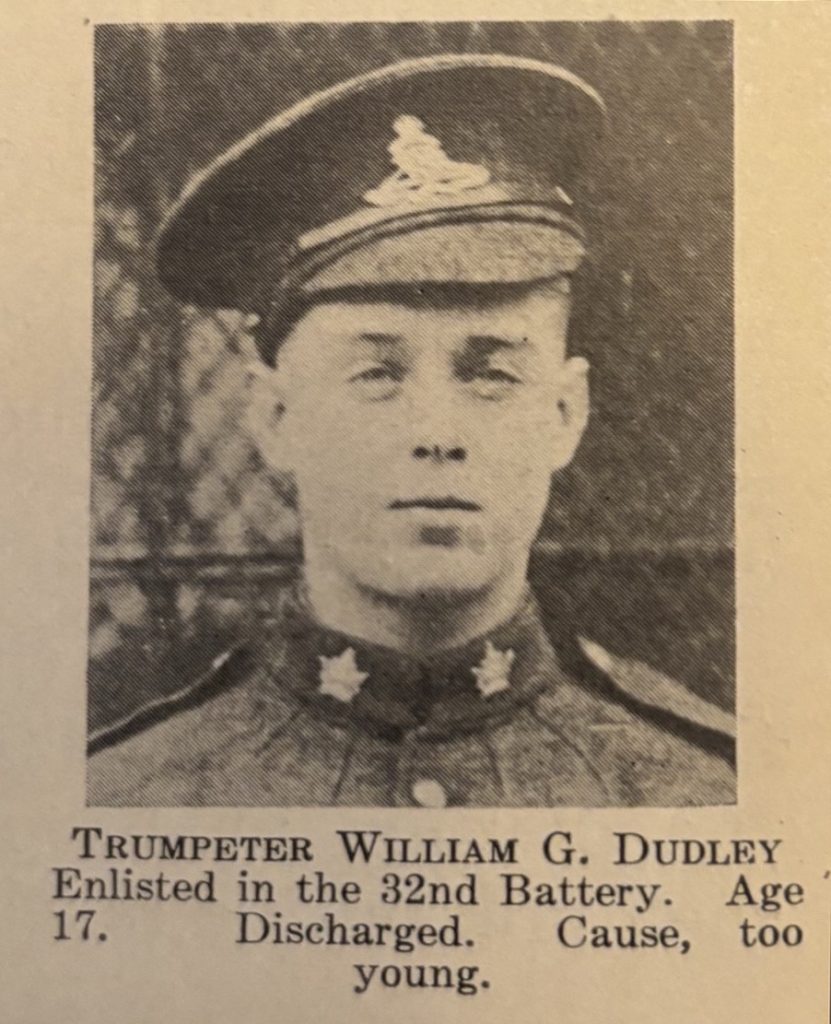
In early February 1917, Dudley’s superiors received reports that he was underage. Despite the urgent need for manpower — particularly with preparations underway for the Battle of Vimy Ridge — the army took the discovery seriously. It’s possible Lottie’s published letter exposed his true age. Another report suggested his brother alerted authorities.
Whatever the reason, Dudley was sent to Shorncliffe, England in late February, where he performed office work before being returned home from Liverpool in May with the “disability” listed as “underage (16 ¼).” He was discharged at the Canadian Discharge Depot in Quebec City on June 13. His papers noted he had grown to five feet seven inches — more than a foot taller than when he enlisted just 21 months earlier — and described his military character as “good.”
He received a Class A War Service Badge and a cheque for $100.10 covering his final three months’ pay.
Dudley was one of the lucky underage soldiers who returned home. It is estimated that 2,000 underage Canadians were killed in action.
He later fulfilled his wish to serve again, joining the Canadian Army during the Second World War. He served overseas in Europe from 1941 to 1945.
In recent years, his nephew Jeff Mason told a researcher: “The only hurt he would have to show for both of his military adventures would be the end of his thumb cut off when it was slammed in a jeep door.”
Between the wars — and for the rest of his life — Dudley remained in Hintonburg. He married but never had children. He worked as a waiter at the Carleton Tavern when it opened in 1936, then returned after the Second World War and remained there into the 1960s. He often shared his story and kept his discharge papers and birth certificate handy to prove it to anyone who doubted him.
Upon retiring from the Carleton, he was presented with his serving tray, which remains in the family today. Dudley died in 1972.