
By Sarah J. Harb
Grocery prices haven’t gone back down. What used to be two or three bags of groceries has turned into one — often for the same cost. That difference is being felt in cupboards and fridges across Ottawa — and increasingly, at local food banks too.
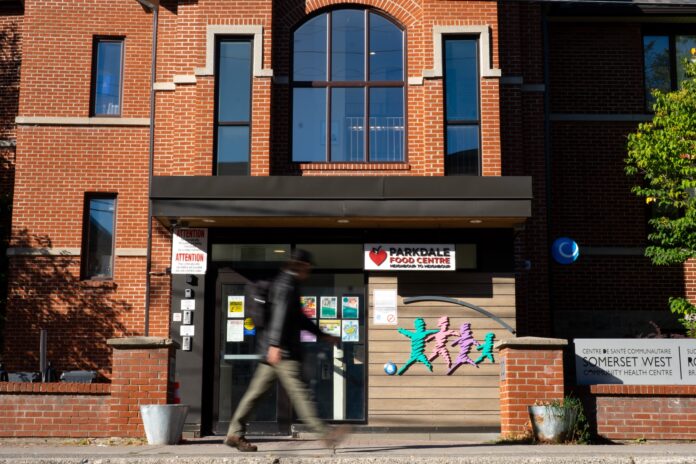
At the Parkdale Food Centre, even basic staples are becoming too expensive to buy at previous levels.
“Things like milk, cheese, yogurt, eggs — eggs are huge,” said Beth Ciavaglia, executive director of the Parkdale Food Centre. “Those are really in-need items, but we can’t continue to purchase at the old volume. We just can’t afford it.”
The strain shows up in the numbers, too. Food prices rose 27 per cent between July 2020 and July 2025, according to the 2025 Ottawa Hunger Report. In 2024, more than one in four Ottawa households — 25.7 per cent — experienced food insecurity, up from 15.3 per cent in 2019.
Meanwhile, visits to programs supported by the Ottawa Food Bank have more than doubled from pre-pandemic levels, reaching 588,866 during the 2024–25 fiscal year. The Hunger Report found 72 per cent of member food banks were also having to purchase more food themselves because donations haven’t kept pace.
Parkdale feels that gap directly. The centre gets about half its food from the Ottawa Food Bank; stocking the rest costs roughly $17,000 to $18,000 a month, plus another $5,000 for its community kitchen, Ciavaglia said.
Demand explains much of that cost. The kitchen used to serve about 100 meals at a time, a number that’s climbed to between 150 and 170. On one recent day, it served 200.
To offset those costs, Parkdale has been partnering with local farms that share its values.
“Food is a human right. Good food,” Ciavaglia said. “Everyone deserves access to good food.”
Farms including Juniper Farms, Grazing Days and Terramor Farm ask customers to donate to the centre. Those funds are set aside and used to buy food directly from the farms, connecting the centre with new supporters while helping stock its shelves with fresh, local food.
“It supports the local farmers, but also allows our neighbours to get the freshest, best food that we all want access to,” Ciavaglia said.
The centre continues to look for partnerships with other local businesses.
Demand stretches Westboro food bank
At the Westboro Region Food Bank, many of the same pressures are playing out in the basement of All Saints Anglican Church.
The food bank operates twice a week — Tuesdays and Thursdays — and takes more than 30 appointments a day, with each appointment representing anywhere from one to 10 people. That means the food bank can serve dozens — and sometimes hundreds — of people in a single day.
Rev. Chung Yan Lam, associate priest at the church, oversees the food bank’s portfolio.
“We used to be able to buy more with our money, and we no longer can buy as much… the need for food has increased,” Lam said.
Interest rates are higher, which means landlords are charging more, Lam said, while subsidies such as Ontario Works have not kept pace with living costs.
“Our food bank, which has never been intended to be a permanent solution of any kind, but a temporary band-aid of sorts continues to be overstretched to cover something that it has never been able to,” she added.
Even with less buying power, the food bank has worked to keep its shelves reflective of the people it serves. Through the Ottawa Food Bank’s Global Marketplace grant, Westboro stocks culturally appropriate staples — lentils, couscous, dates, bulgur and certified halal beef — so no one has to choose between their faith or culture and going hungry.
Donated pastries from Lionhearts and COBS Bread are on offer too, something Lam said matters more than it might seem.
“It’s the dignity that is returned… to be able to provide some treats,” she said.
Winter brings another challenge: getting the food into people’s homes.
Many clients arrive on foot, Lam said, and in snow and ice, heavy canned goods become difficult to carry. Seniors in particular can miss appointments altogether.
The food bank partners with Feed the City, whose volunteers deliver food directly to seniors and others who can’t make it in during winter weather.
The food bank also tries to stockpile ahead of the season, though space is tight in the church basement. Each December, it runs an “Advent calendar of giving” — a daily suggested donation item pairing staples such as canned tuna with small comforts like chocolate and cookies. The donations are used to stock a “Christmas shelf,” alongside donated gifts for children.
Starting around Thanksgiving, the food bank ramps up outreach to churches, schools and businesses for food drives. On Dec. 12, the Westboro BIA will run its annual holiday campaign outside the church, collecting donations for the food bank and two other local charities.
Historically, January and February are the months when the bank experiences shortages, Lam said — part of why she’s encouraging people to think of the food bank when finalizing their year-end giving.
Right now, it’s short on staples such as cereal, peanut butter and canned meat. But some of the more persistent shortages aren’t food at all: larger-size diapers, feminine hygiene products, adult incontinence supplies and basic toiletries.
Parkdale searches for a new home
Back at Parkdale, a different kind of challenge is looming — one that has nothing to do with the price of groceries.
Its Mino’Weesini grocery program at 5 Hamilton Ave. N. is set to be displaced by redevelopment, meaning the centre will eventually need to find a new home for the program in a neighbourhood where suitable space is scarce and costly.
“We don’t want to leave the neighbourhood, and we acknowledge that space in this neighbourhood is hard to come by and very expensive,” Ciavaglia said. “There absolutely is a concern amongst all of us about that ability.”
The search has already been underway for about a year.
“Our worst case scenario is that we move in two years. Our best case scenario is four, but we’re really planning for now,” Ciavaglia said. “We need to put everything in motion right now.”
For a centre already trying to stretch every dollar further as the number of people needing help grows, finding enough food is only part of the challenge. Soon, Parkdale will also need to find enough space to keep providing it.