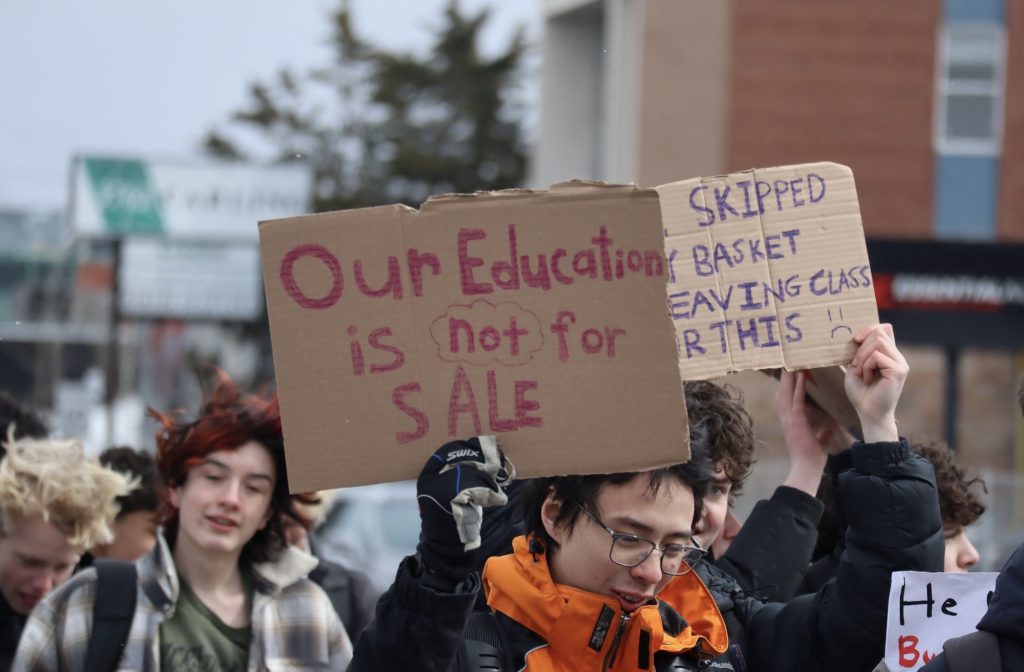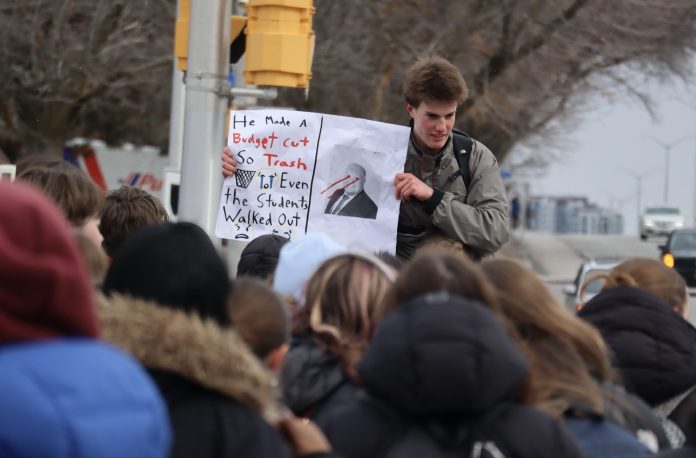

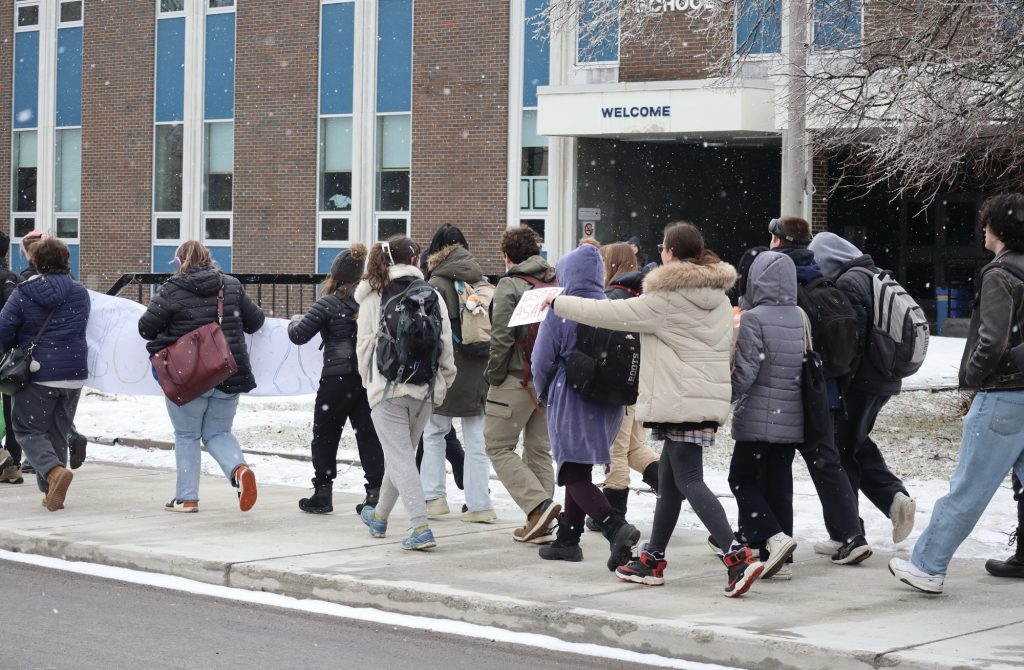
Soon after the afternoon bell rang on March 10, clusters of students began slipping out the doors of Nepean High School, holding signs to stage a walkout against sweeping changes they say will impact their future post-secondary education.
The roughly 100 or so students marched down Broadview to Carling, where they were joined by a few dozen students from neighbouring Notre Dame High School. They shouted “hands off our education” and “our education is not for sale” before joining other students who were demonstrating outside the Carlingwood Shopping Centre.
It was just one of countless walkouts planned at schools across Ottawa and the rest of Ontario on that Tuesday. Grade 12 Nepean student Max Wishart said the idea took shape after seeing similar actions planned at schools elsewhere in the province.
“We were working with a larger organizing group to coordinate actions across different high schools,” Wishart said. “We’d been seeing a lot of conversation about the OSAP cuts and people contacting their MPPs. My friend Megan asked if we wanted to take action as well. We started with an Instagram account, and things rolled from there.”
Classmate Ali Hassan said he quickly decided to get involved after learning the protest was happening locally.
“Even people who couldn’t make it were wearing red squares in the school,” he said. “We had people sending supportive messages and teaming up with Woodroffe and Notre Dame — getting school communities together.”
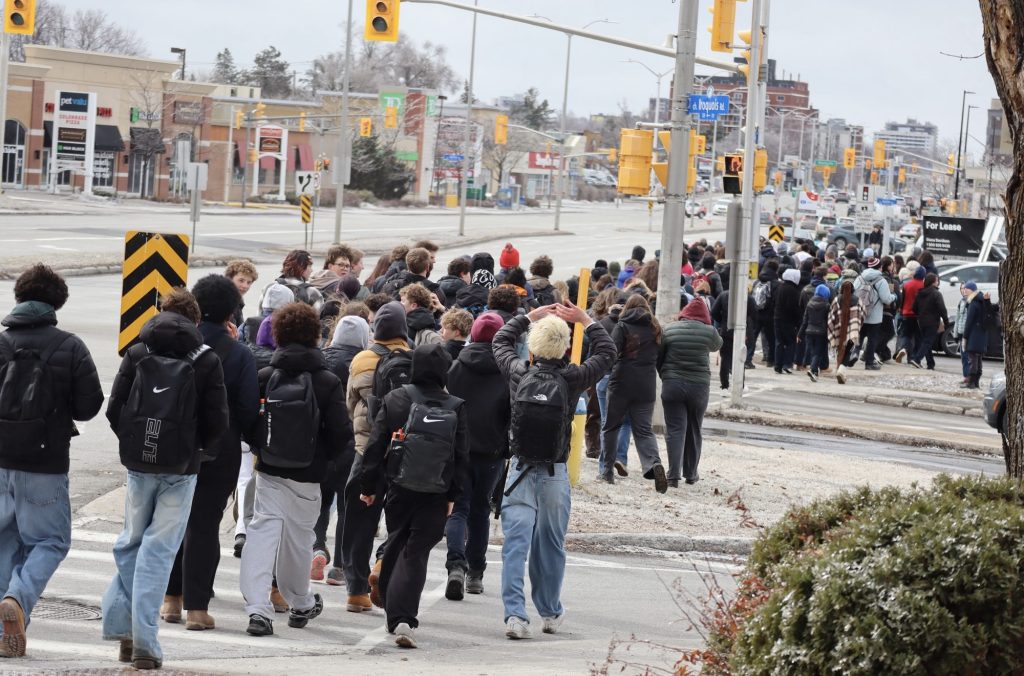
He added that the crowd reflected a wide cross-section of the school.
“It was really cool seeing a wide variety of people from our school community, people I’d never met before, all sorts of grades, particularly Grade 12s. People outside our friend groups showed up. It was great to see how many people were excited and wanted to show their voice and be heard.”
The backlash came after the Doug Ford-led Ontario PC government announced sweeping changes to its Ontario Student Assistance Program (OSAP).
Currently, students can receive up to 85 per cent of their education paid for through grants, with the other 15 per cent covered by loans. Under a new balance shift, the numbers would rotate.
Slated changes would see only 25 per cent of OSAP covered by grants, with the remaining 75 per cent to be repaid through loans.
Wishart, who plans to attend Carleton University to study biology in the fall, said that while they won’t be severely impacted due to parental support and savings, they fear for students from lower-income families who rely on government funding to get ahead.
Hassan, who hopes to pursue a career in health care and possibly attend medical school, said the concern is just as much about classmates as it is about his own future.
“There are several people around me who I know may not end up being able to go to university due to these cuts,” he said. “Friends who have big dreams of going to medical school, becoming teachers, becoming psychologists — fields we desperately need people in.”

He said seeing those worries spread through his peer group helped motivate him to get involved.
Students also pointed to broader financial pressures shaping their post-secondary plans, including housing costs and a difficult job market.
Wishart said many classmates are already adjusting their expectations.
“For many, we’re choosing schools closer to home because we can’t afford to move,” said Wishart. “My friends aren’t only worried about how they’ll pay tuition. They’re worried about how they’ll find jobs and where they’ll live.”
Wishart added that competition for entry-level work has become tougher as older, more experienced workers take positions that students traditionally relied on.
Hassan said he has experienced that challenge personally.
“I’ve struggled to find employment despite certifications like lifeguarding,” he said. “I’ve been applying widely with little luck.”
Students also raised concerns about how emerging technologies could shape the labour market by the time they graduate.
In a statement, the Ministry of Colleges, Universities, Research Excellence said the funding model changes are necessary to “restore sustainability to OSAP and ensure its availability for future generations.”
OSAP currently costs taxpayers $2.7 billion, the government said, and could rise to $4 billion by 2029 if the current ratio remained in place.
“Our government has been clear, due to billions of dollars of pressure on the program from the federal government’s decision to remove grant eligibility from students at private career colleges, coupled with increased program uptake in recent years, the OSAP framework was no longer sustainable,” the statement read.
But students hope the province should reconsider and said they aren’t equipped to cover such a heavy financial burden to access greater education. Hassan argued the province already ranks low in support compared to other jurisdictions despite hosting major universities.
Students say the March 10 demonstration is unlikely to be the last.
“We will continue doing these walkouts,” Wishart said. “You cannot stop students. Young people are the face of change.”
Algonquin votes to suspend 30 programs
Despite fierce pushback and opposition, Algonquin College’s board of governors voted March 2 to suspend 30 programs amid increasing budget pressures.
The cancelled programs will include many in the Faculty of Media Arts and Design, with journalism, design foundations, museum studies, and music industry arts all getting the chop. In the school of business and hospitality, the paralegal, law clerk, travel, art wing, and events management programs will also soon be gone. Algonquin also voted to cut its horticulture programs and its Pre-Health Pathway to Certificates and Diplomas
In an email to students ahead of the vote, Algonquin College said the recommended cuts reflected several factors, including shifts in learner demand, changes in federal policy and provincial funding, and our focus on programs that support strong career pathways.”
A follow-up email said “financial mitigation efforts must continue to ensure the College’s long-term sustainability”, which includes aligning programming with enrolment, labour market needs, and financial reality.
On March 9, a few dozen students protested outside Algonquin’s Woodroffe campus, holding union flags and demanding the board of governors reconsider its decision.
Many local groups and organizations, including The Ottawa Music Industry Coalition, Ottawa Festival Network, the Ottawa Coalition of Business Improvement Areas, and the Ottawa Film Office, have written letters to the college stating that they hire from the impacted programs.
Ottawa-West Nepean MPP Chandra Pasma, who spoke at the rally, said Ontario doesn’t have enough educational funding because tuition was frozen for eight years starting in 2018
Last year, Algonquin also voted to suspend 37 programs and announced it was selling its Perth campus.