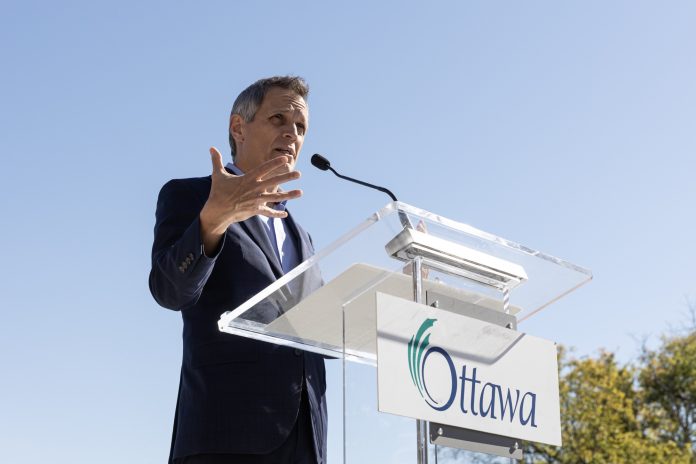

Four years after winning the mayor’s race as a political newcomer, Mark Sutcliffe is asking Ottawa voters to give him a second term.
Sutcliffe was elected mayor in 2022 after campaigning on affordability, fiscal restraint and improving basic city services. Heading into the 2026 election, those themes remain, alongside new commitments including cheaper transit fares, more buses and police officers, infrastructure spending and a target to end youth homelessness.
Sutcliffe has made lowering OC Transpo fares a major part of his re-election campaign, promising to reduce an adult monthly pass from $138.50 to $95 — a savings of more than $500 a year for someone who buys a pass every month.
His proposal would also introduce a $10 daily fare cap and a two-hour transfer window. Free transit for youth would become permanent during the summer and on evenings and weekends, while Para Transpo fares would be reduced. He is also proposing a bulk transit-pass program for major employers, including the federal government.
The plan calls for another 200 buses by 2030, 250 additional drivers and mechanics, and the return of several suburban express routes.
For Kitchissippi, another proposal would see a continuous bus lane along Carling Avenue between Lincoln Fields Station and Sherwood Drive, part of more than $1.3 billion in bus rapid transit and continuous bus-lane projects.
Much of the plan is tied to the proposed transfer of Ottawa’s LRT infrastructure to the Ontario government. Sutcliffe has characterized the agreement as a roughly $4-billion provincial investment, with financial capacity created by the arrangement reinvested into OC Transpo. His campaign also argues that lower fares would attract more riders, offsetting some of the cost through increased fare revenue.
Keeping property taxes low was central to Sutcliffe’s first campaign. The citywide increase was 2.5 per cent in 2023 and 2024, meeting his initial commitment to keep increases between two and 2.5 per cent. It rose to about 3.9 per cent for an urban homeowner in 2025, while the 2026 budget included an overall 3.75-per-cent increase.
Sutcliffe is promising to limit increases to between two and 2.5 per cent in each of the first two years of a second term. He is also pledging another $250 million in savings over four years, including through a hiring freeze for some non-frontline positions and further reviews of city spending.
Sutcliffe said Kitchissippi homeowners could eventually face another affordability pressure when Ontario resumes property reassessments, which have been postponed since the pandemic.
“When those property reassessments happen, there are many residents in Ottawa, even if we froze taxes, their taxes would go up because of the increased value of their assessments. So any property tax increases are on top of some of the reassessments that are going to take place,” he said.
Public safety is another area where Sutcliffe is promising new spending. His campaign has pledged to hire 200 additional police officers, 100 paramedics, and 50 firefighters, while expanding community policing and measures to improve safety on transit and in public spaces.
Sutcliffe said his approach would combine enforcement with more treatment and mental-health services.
“We need to take a balanced approach where we’re investing in public safety solutions, but we are also investing in caring for the vulnerable people who have unfortunately suffered through the toxic drug crisis or have experienced mental illness,” Sutcliffe said.
He also wants to expand further ANCHOR, Ottawa’s alternative crisis response program, which sends civilian crisis workers to some calls rather than police.
Sutcliffe has pledged to end youth homelessness in Ottawa by 2030 and is proposing thousands of additional affordable, supportive and transitional homes.
Housing presents a different challenge in Kitchissippi, where intensification has reshaped portions of Richmond Road, Scott Street and Wellington Street West.
Sutcliffe said Ottawa needs significantly more housing to accommodate population growth, but believes much of it should be concentrated around rapid transit and major corridors.
“We have to build around public transit and around major routes without upsetting the character of local neighbourhoods,” he said. “And I know Kichissippi has carried a lot of the weight of intensification over the last few years.”
His housing platform calls for approvals for tens of thousands of additional homes by 2030 and greater use of publicly owned land.
Infrastructure has also taken on greater urgency following severe flooding that affected thousands of properties in Ottawa this year, including in Bay Ward.
Sutcliffe’s campaign is proposing hundreds of millions of dollars in infrastructure investments to withstand better severe weather, including storm sewer and drainage work.
“We need to look neighbourhood by neighbourhood at what caused the flooding,” Sutcliffe said. “And I’ve committed that whatever infrastructure improvements we need to make to protect residents from flooding in the future, we will make those investments.”