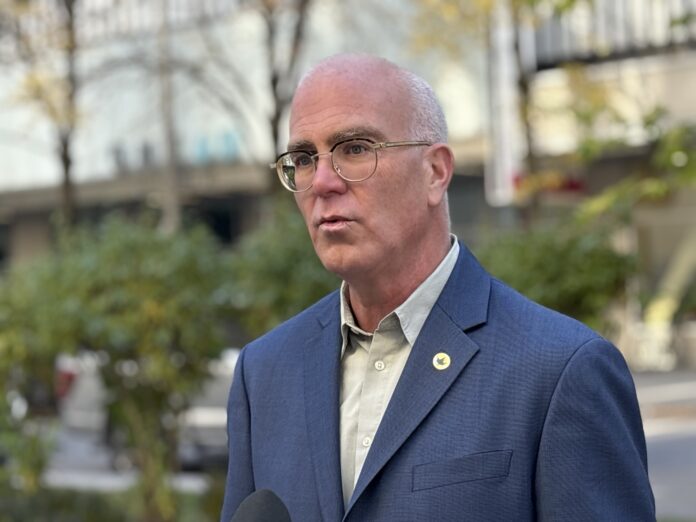

Jeff Leiper believed he had a real shot at becoming Ottawa’s next mayor.
After months of campaigning across the capital, knocking on doors and pitching his vision for a more equitable city, he felt the desire for change — an opportunity to bring a more progressive voice to city hall.
But voters had another vision.
Incumbent Mayor Mark Sutcliffe was voted back to city hall for a second term with about 46.5 per cent of the vote, a small decrease from the 51 per cent he took back in 2022. Leiper came in second place with 33.9 per cent, or about 33,535 fewer votes. Economist Neil Saravanamutto earned 11 per cent of the votes, with homebuilder Alex Lawson getting 7.5 per cent. The results were similar to those suggested by recent polls.
When Leiper sat down with the Kitchissippi Times the following morning, there was little indication of defeat.
Gone were the crisp white shirts he had frequently worn on the campaign trail. Instead, Leiper arrived for his first interview as an ordinary citizen wearing jeans, a University of Ottawa Gee-Gees hoodie and a green sweater.
He wasn’t particularly sad. In some ways, he was relieved.
After more than a decade of dealing with neighbourhood concerns, contentious council meetings and the demands of public office, Leiper was looking forward to a quieter day. He planned to spend the afternoon reading a book from the Spaniel’s Tale in Wellington Village.
“I have my head held high. I have had a smile on my face for most of the morning as colleagues and residents have reached out to me. I’m proud of what we did,” Leiper said. “I’m a little uncertain as to what comes next, but I am optimistic.”
Leiper had actually originally planned to be out of the municipal office by now. When the last race in 2022 was over, he said it would be his last term. But a strong discontent with the city’s transit service is what made him run for mayor in the first place.
Throughout the campaign, Leiper promised a transit service guarantee, offering OC Transpo riders a refund if stats showed unreliability. He also said a citizen would once again sit on the transit commission — a position he had once supported eliminating — and restore bus cuts effective April 2025.
Leiper believes that part of his platform resonated with voters. But he also wouldn’t commit to lowering transit fares, unlike his opponent, the incumbent Sutcliffe, who said he’d lower the cost of a monthly pass to $95 — saving the average rider around $500 a year.
But what could have helped cost Leiper the election was his unwillingness to give an exact number on how much he’d raise property taxes. It was a jab Sutcliffe regularly took at his opponent during mayoral debates.
Sutcliffe said he’d raise them around two per cent hearty for the next two budgets. Lawson said he wouldn’t raise taxes this year, and then raise them slowly over the next three years.
Leiper said there will be plenty of time over the coming weeks to break down his strategy and discuss what did and didn’t work.
“I’m going to spend probably a couple of weeks talking with the team and picking that strategy apart. When I look at the options I had for presenting the need for modestly higher taxes, there were several ways in which it could have been presented,” he said. “I continue to be comfortable that this was the one that was least likely to create a backlash. I’ll be thinking about it for quite some time.”
Despite the loss, Leiper remained proud of his campaign, particularly the camaraderie among volunteers and the involvement of younger residents. He pointed to his proposal to expand eligibility for the discounted EquiPass transit fare to minimum-wage earners as one of the policies that best reflected his values.
His broader message, he said, was that Ottawa could not measure its success solely through the experiences of its more financially comfortable residents.
“We don’t succeed as a city unless the most vulnerable people in our city succeed,” he said.
A lasting mark on Kitchissippi
While Leiper’s bid for mayor ended in defeat, his departure from city hall also marked the conclusion of a significant chapter in Kitchissippi’s history.
First elected in 2014, Leiper defeated incumbent Katherine Hobbs and went on to serve three consecutive terms representing neighbourhoods including Westboro, Hintonburg, Wellington Village and Mechanicsville. In each election, he took a strong majority of votes.
A former community association activist, journalist and technology industry analyst, he brought a particular emphasis on neighbourhood engagement, active transportation, planning and community development to city hall.
Over those 12 years, Kitchissippi changed considerably. New condominium towers rose along major corridors, businesses opened, public spaces were renewed, and the debate over intensification became a defining local issue. And there was, of course, the arrival of light rail.
Leiper supported much of that growth, even when it proved unpopular with some longtime residents. He argued that increased density helped sustain the independent businesses and amenities that made the ward attractive. What developers want built is also allowed to be built, which ultimately comes down to the city’s Official Plan and provincial regulations.
“Spaniel’s Tale doesn’t exist without the foot traffic that density creates,” he said. “There are new towers on the periphery of our ward that many people don’t like, but those new residents in their several thousands are contributors to a much more vibrant business and amenity environment.”
Among his proudest accomplishments were investments in neighbourhood parks and fieldhouses, including improvements to Laroche Park and Tom Brown Arena, as well as community programming and events.
He pointed to the Kitchissippi Winter Trail, the Hintonburg 5K, and the Parkdale Night Market as examples of community-building initiatives that helped make the area more vibrant.
Affordable housing was another priority. Leiper directed development-related community benefits funding toward non-profit housing initiatives, including projects involving Centretown Citizens Ottawa Corporation and the Ottawa Community Land Trust.
But perhaps his most recognizable contribution was the way he communicated with residents. For 12 years, Leiper held regular pop-up office hours, giving constituents opportunities to raise concerns directly. His weekly Saturday newsletter offered updates on planning applications, municipal decisions, neighbourhood events and issues affecting the ward.
“I think I’ve changed people’s expectations of the accessibility of a councillor,” he said.
Leiper believed those efforts helped residents better understand the city hall and made municipal government more accessible. Still, he acknowledged that public office came with a personal cost. The demands were relentless, and not every interaction was pleasant.
On election night, one resident sent him a mocking animation accompanied by a message laughing at his defeat.
“I don’t know whether that guy is proud of his behaviour, but it’s not uncommon. And I will not miss that,” he said.
Now, that responsibility passes to councillor-elect Joanne Chianello, who won the open Kitchissippi race with more than 65 per cent of the vote.
Leiper — who endorsed Chianello — hoped she would continue to prioritize affordable housing and ensure the ward’s growing prosperity was accessible to residents of all income levels.
His own future remained uncertain. He said he would need to find work, preferably in a quieter, less public-facing role involving policy and writing.
For now, though, there was time to reflect.
“I am in the very fortunate position of loving my neighbourhood more today than I did when I got elected,” he said. “It has been a privilege of a lifetime.”