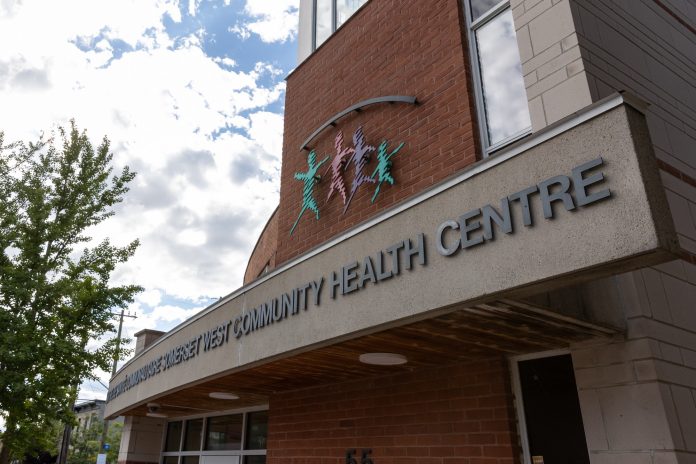

On a rainy, cold November afternoon, people gather outside the Somerset West Community Health Centre to use illicit drugs — a direct result of the supervised consumption site’s closure. Those who stay on the property do so because nurses inside can respond to overdoses with naloxone, unlike incidents that happen across the street or throughout Chinatown, where paramedics take over.
Somerset West is one of more than two dozen clinics across Ontario forced to pivot from supervised consumption to the province’s new HART Hub (Homelessneass and Addiction Recovery Treatment) model — part of a sweeping legislative shift that is reshaping how drug use, harm reduction, and recovery are handled on the ground.
The change came after the Ontario government passed the Community Care and Recovery Act, part of the larger Safer Streets, Stronger Communities Act, known as Bill 223.
The legislation bans supervised consumption sites within 200 metres of schools or child-care facilities, restricts municipalities from establishing or supporting SCSs, and prevents them from seeking federal drug possession exemptions without provincial approval.
Shawna Thibodeau, a local Ottawa community support worker, says that since the closure of the SCS at Somerset West there’s been a noticeable difference in the neighbourhood.
“You didn’t always see the people who were using. If they were inside, you didn’t see them using—you saw the after-effects. You saw them outside afterward, but you didn’t see them using as much,” she said.
“I fear for their safety. The overdose thing, the dirty drugs—I fear that if they’re not in a safe consumption area, that more and more regular people are going to start seeing what [SCSs] used to hide. I’ve got friends on the inside who talk about the overdoses and the body bags.”
Increased policing
Her concerns are unfolding at the same time as the neighbourhood is absorbing other pressures, such as increased police activity in neighbouring parts of the city.
In June 2024, Ottawa Police opened the Neighbourhood Operations Centre (NOC) at 50 Rideau Street, part of the force’s Community Outreach, Response and Engagement (CORE) strategy. The new unit focuses on deterring and preventing crime in areas facing persistent safety concerns. A year later, in July 2025, police announced an expanded summer presence in the ByWard Market and Downtown Rideau, targeting crime and what they called “social disorder.”
The initiative drew praise from the ByWard Market District Authority (BMDA). Vice-Chair Suzanne Valiquet told City Council on June 25, 2025, that both businesses and residents felt safer with a stronger police presence in the district.
But what was welcomed downtown has created a cascade of unintended consequences just a few blocks west, say residents.
“The City of Ottawa last year identified eight hotspots in the ByWard and Sandy Hill area,” said Garvin Snider, who lives in the Chinatown area. “So they increased the police presence there and put the satellite police office in the Rideau Centre. Some of the unintended consequences were that it pushed people down this way.”
Snider also expressed concerns about a shortage in available services since Somerset West transitioned from an SCS to a HART Hub.
“You can go there and get a sandwich, you can get a little cup of water, but you can only have a shower there if there’s enough staff—and most of the time there’s not enough staff.”
An increase in funding
Ontario’s provincial government has promised $529 million for the creation of 27 HART Hubs across the province, with Somerset West being one of the first to receive approval from the Ministry of Health confirming their required Business Transition Plan had been approved.
In a Jan. 2, 2025, news release, the province stated: “These hubs will be eligible, on average, to receive up to four times more funding to support treatment and recovery under the model than they receive from the province as a consumption site. To assist with transitioning, the sites will also receive one-time funding for start-up costs.”
Alongside that commitment, under the province’s Roadmap to Wellness, is a further $3.8 billion over 10 years to go towards creating new services and programs for mental health and addictions care.
In that same news release, HART Hubs are described as offering a range of services—just not safe consumption, safe supply, or clean needle supply.
“HART Hubs, similar to existing hub models in Ontario that have successfully provided people with care, will reflect regional priorities by connecting people with complex needs to comprehensive treatment and preventative services. These include a range of services to meet local needs such as primary care, mental health services including addiction care and support, social services, and employment support.”
Part of the goal of a HART Hub is to provide addiction and recovery beds and supportive housing units, with the long-term goal of transitioning people into independent, stable housing.
Using the wraparound care model
While each HART Hub will operate a bit differently depending on the specific needs of their clients, Derrick St. John, Director of Supportive Housing and Substance Use Health at Somerset West, says its supports are based on the wraparound care model.
“Community health clinics are so well positioned, because this is the kind of work that CHCs have always been doing—that hub-and-spoke model. A community health center is the hub, and we try to do as much as we can internally, and then point people in the right direction,” said St. John.
“We’re open 9:30 a.m. to 7 p.m., six days a week, and we open at noon on Thursdays. And literally, someone comes to the back door, they ring the doorbell and ‘Hey, I’m here for HART Hub,’ they walk in, and we ask ‘How can I help you?’ ‘Oh, I just want a sandwich and a shower.’ ‘Okay, have a seat here. We’ll have our person get that for you.’”
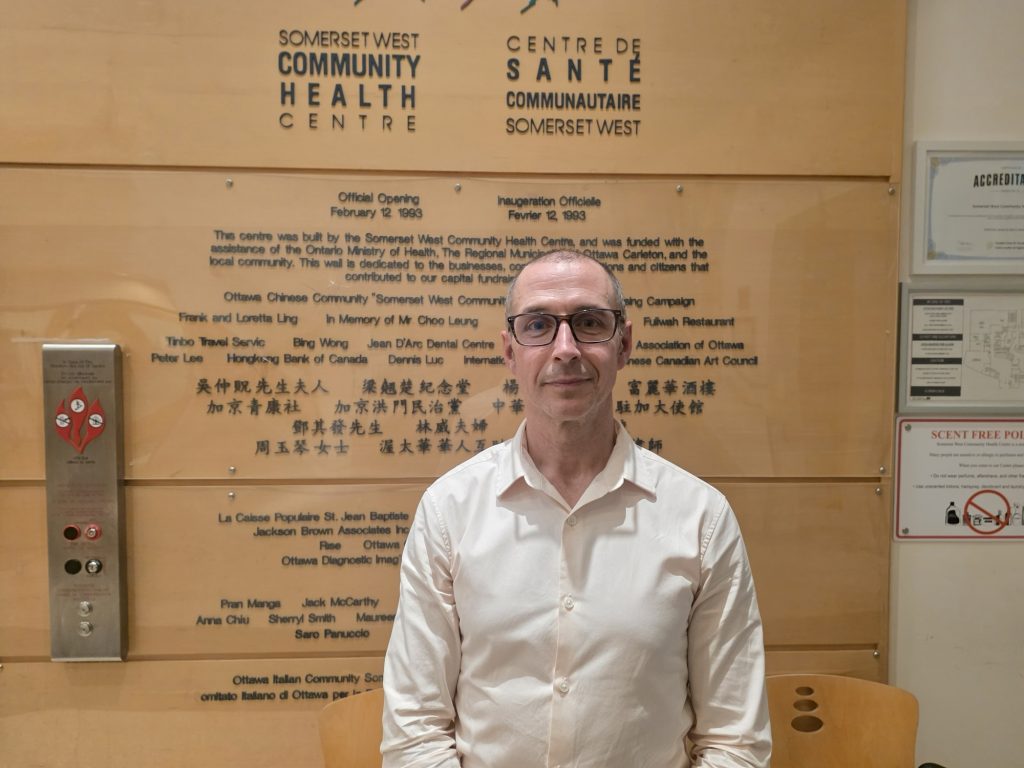
If a client needs to see a counsellor, a nurse, someone to help with housing intake, or even help with their taxes, it’s all offered on-site, says St. John.
“The nurse sees the patient and asks, ‘Do you have a family doctor?’ and if not, we could provide you with one if you identify as having mental health or substance-abuse issues.”
“If we need a psychiatrist, we have to outsource that. But if we need a family doctor, well, our clinic is nurse practitioner–based and we have that in-house. We have our counselors in-house, we have systems navigators, and a housing case manager on-site.”
St. John acknowledges it’s still not a perfect model and the complexities of addiction make it difficult at times to quantify what success looks like.
“We’re seeing people in terms of [addiction] where their substance-use gauge is buried, right? Substance abuse is really the main thing in their life. So if we can work with people and take that gauge and move it [to the middle]—and it’s not necessarily based on abstinence, knowing that recovery looks different to everyone—if it’s at a level where that person is able to establish goals, ‘I’m talking to a friend, I saw my kid’… that’s success, right?”
The question of abstinence is one that critics of the province’s move to HART Hubs have also levelled, with some concerned that funding of the new model is tied to clinics using abstinence-only programming.
St. John clarified: “Currently we’re not hearing anything about abstinence or mandatory treatment, but I don’t know what the future is.”
For now, says St. John, Somerset West is determined to deliver the full range of care available under the mandate they’ve been given by the province.
“We don’t have all the answers. But we truly need people to be invested in this at all levels and to support what’s happening to the workforce, for housing, addiction, mental health, social services. And we also need that long-term investment in families and health and healthy communities so that people are not isolated.”
Overdose calls are up in Somerset
While the Ontario government closed safe consumption sites near schools and daycares to keep illegal drug use away from children, data from the City of Ottawa shows overdose calls to paramedics in the Somerset area are actually up 19 per cent.
Between March 1 and Sept. 30, 2024, there were 89 overdose calls to paramedics. During the same period this year, that number sits at 106 calls.
The data includes Anderson Street to Somerset Street West, Eccles Street from Booth Street to LeBreton Street North, LeBreton Street North from Somerset Street West to Eccles Street, and Somerset Street West from Booth Street to LeBreton Street North.
Beyond overdoses, area Coun. Ariel Troster has said the safe consumption site closure has led to “an explosion” of opioid use throughout the Chinatown community. She said examples have included a mother finding needles in her child’s stroller and a business owner being pricked with a needle while gardening outside his business.