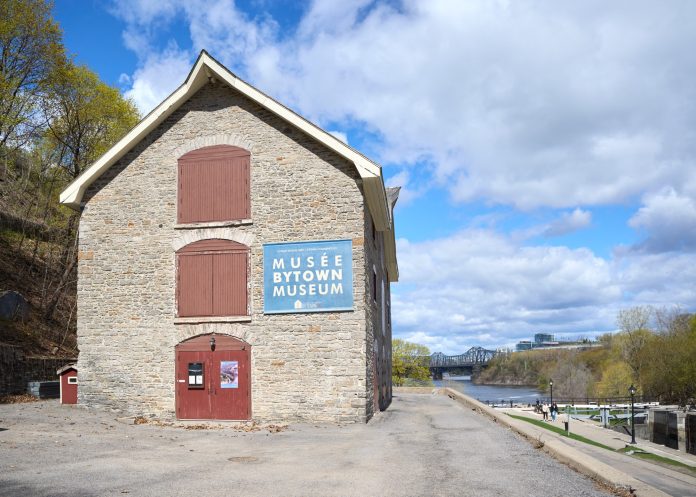

On the edge of the Rideau Canal, where green water slips past the Ottawa locks before meeting the Ottawa River, sits a squat stone building that predates the country.
Built in 1827 during the construction of the Rideau Canal, the old Commissariat building once served as the military supply hub for Colonel John By’s ambitious engineering project. Inside its thick limestone walls were offices, records, food stores, money, gunpowder and alcohol destined for the thousands of workers carving a water route through the wilderness between Ottawa and Kingston.
Today, the building houses the Bytown Museum.
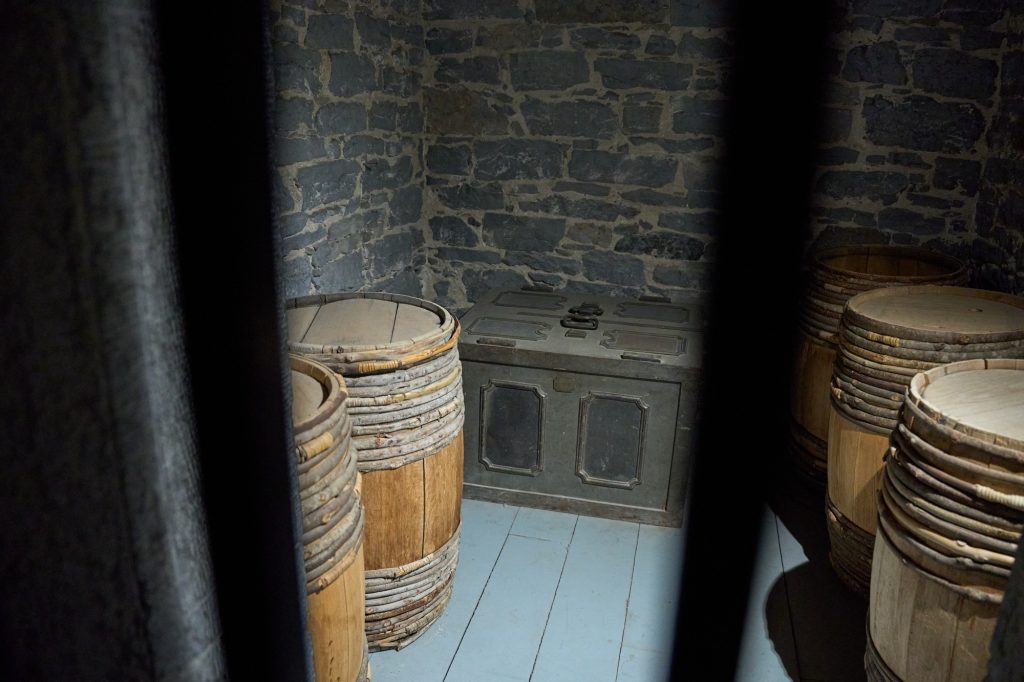
Much of the structure remains remarkably unchanged. The heavy wooden rafters overhead are original. So is the vault where supplies and spirits were once locked away.
Founded by the Women’s Canadian Historical Society of Ottawa in 1917, the museum moved into the building in 1951 and opened there the following year.
The museum’s permanent exhibition, Where Ottawa Begins, traces the city’s story from long before Bytown existed through to the First World War. Along the way are thousands of artifacts tied to canal workers, lumber barons, politicians, soldiers, photographers and ordinary residents who helped shape the capital.
Long before Colonel By arrived, the Ottawa, Rideau and Gatineau rivers served as gathering places, transportation corridors and trade routes for Indigenous communities. A recent renewal of the museum’s galleries has placed greater emphasis on those histories and perspectives.
Towering over the entrance staircase is River to Sky, a two-storey mural created by local Indigenous artists Claire Brazeau and Emily Brascoupé of the Three Sisters Art Collective. Nearby are some of the museum’s oldest objects: stone tools discovered along the banks of the Kichi Zībī, or Ottawa River.
“These are some stone tools that are found along the banks of the Kichi Zībī or the Ottawa River,” said Chloe Dennis, exhibition and collections manager at the Bytown Museum.
From there, the museum moves into the arrival of Colonel John By and the massive undertaking that transformed a rugged settlement into Bytown.
One display contains a trunk that belonged to Colonel By himself. Beside it are silhouettes of By, his wife and daughters, considered among the only true likenesses of him.
Another artifact reflects the prestige and politics tied to the canal project. The Drummond Cup, a silver presentation cup commissioned by By for contractor Robert Drummond, is considered one of the museum’s most valuable objects. Inscribed on the side is May 1831 — the canal’s original completion target. The waterway would not officially open until the following year.
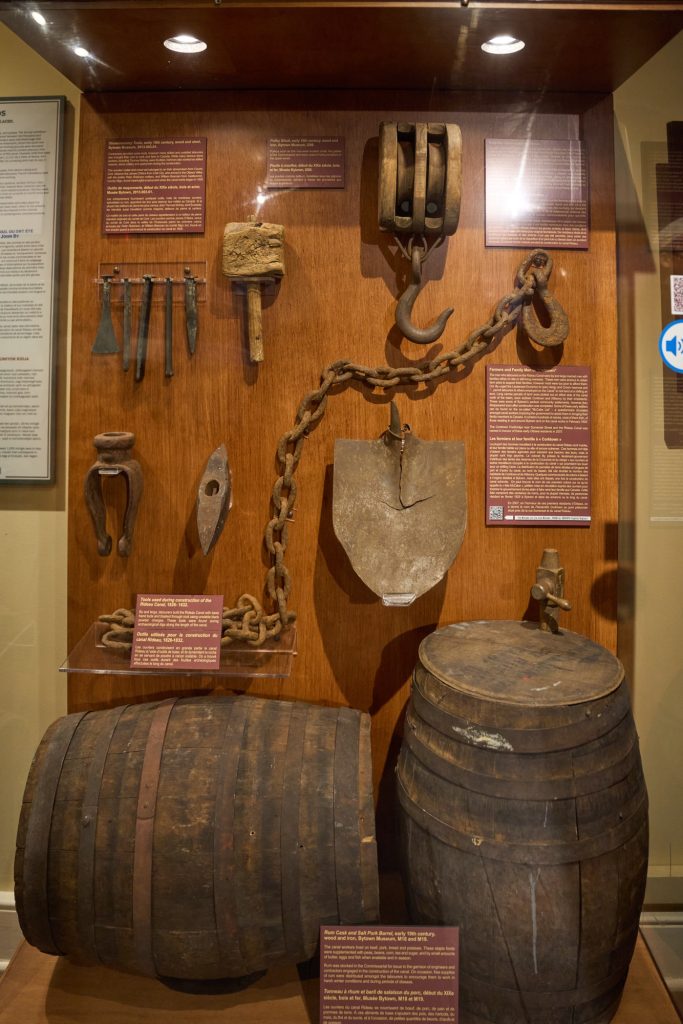
It was a tough life for the labourers who built the canal. Most were Irish immigrants, along with Scottish, English, French Canadian, and American workers who spent years clearing forests, blasting rock, and digging channels through swampy terrain.
“It was really hard, laborious work,” Dennis said. “They worked long days, six days a week. There was disease, danger, explosions, things like that.”
The museum estimates roughly 1,000 workers died during canal construction.
Even the vault downstairs tells part of that story. Dennis pointed out that the original stone floor had to be replaced with wood because workers’ spiked boots could spark against the stone.
The lumber era
There are also large historic photographs showing mountains of stacked lumber once lining the Ottawa River. A detailed model of the E.B. Eddy lumber complex — originally displayed at the Philadelphia World’s Fair — demonstrates the scale of the industry that once dominated the region.
Other artifacts feel more personal: heavy cork boots used by loggers, tools belonging to canal supervisors, and paintings depicting the rough camps and mills that emerged along Chaudière Falls.
The museum also highlights stories that were overlooked for generations. One watercolour showing Philemon Wright’s first timber raft on the Ottawa River long omitted the presence of London Oxford, believed to be the first Black man in the Ottawa Valley and a businessman who worked alongside Wright.
“We found the raft manifest that listed all the people on the boat, and London Oxford’s name is on there,” Dennis said. “He was very much a key figure at the start of the lumber industry in Ottawa.”
In the mid-1800s, Bytown had a reputation for violence, taverns and class division. Rivalries between Irish and French Canadian workers frequently erupted into conflict, while Upper Town and Lower Town residents competed economically and politically.
One section explores the story of Mother McGinty — born Sarah Ritchie — the formidable tavern owner of Corktown, the Irish settlement near today’s Corktown Footbridge.
“She was known to be a very domineering woman,” Dennis said. “Keeping people’s bar tabs — you couldn’t really get anything past her.”
By 1855, the rough canal settlement officially became the City of Ottawa. A few years later, Queen Victoria selected it as the capital of the Province of Canada, partly because it sat between English and French Canada and far from the American border.
Artifacts from that era include one of the city’s original ceremonial keys and a mayoral chair belonging to Henry Friel, the last official mayor of Bytown.
One of the museum’s most fascinating spaces recreates Ottawa’s Victorian period, when the city tried to shed its frontier image. Delicate mourning jewelry woven from human hair sits beside photographs from some of Ottawa’s earliest studios.
Another display explores the Russell Hotel, once among the city’s most prestigious destinations. Politicians, tourists and literary figures such as Oscar Wilde stayed there before it closed in the 1920s and later burned down.
A city of fires
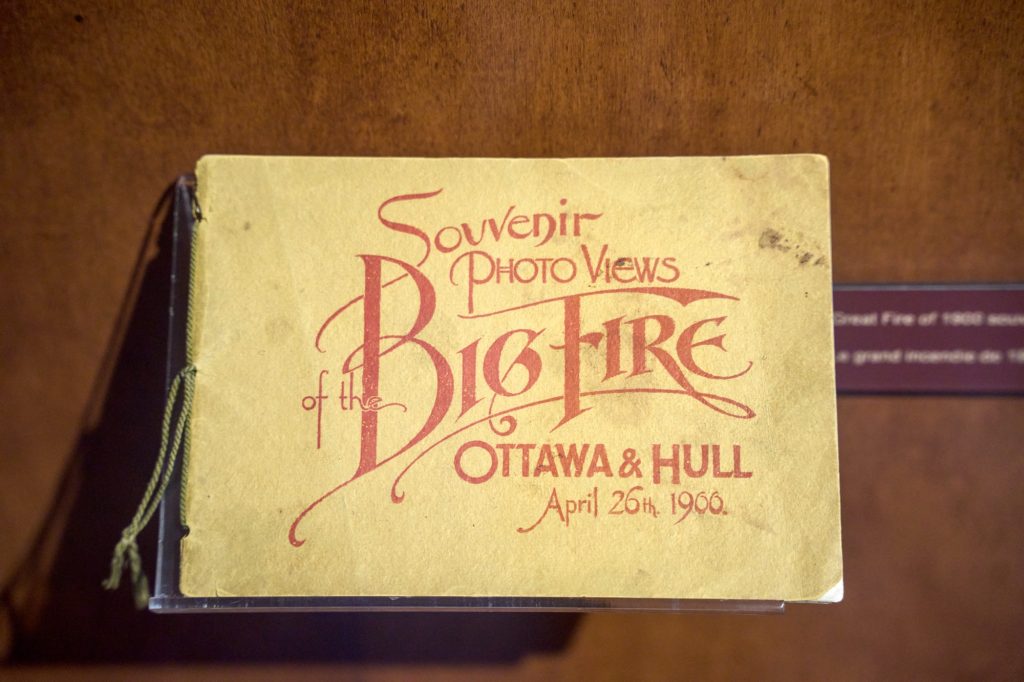
Ottawa has a history of catching fire. The Great Fire of 1900, which spread from Hull across the river through piles of lumber, destroyed huge sections of Ottawa’s west end. Among the surviving objects is a damaged photograph fused with shards of glass from the intense heat.
Nearby are artifacts from the 1916 Parliament fire, including a warped clock hand from the old Centre Block tower and a flag said to have hung from Victoria Tower during the blaze.
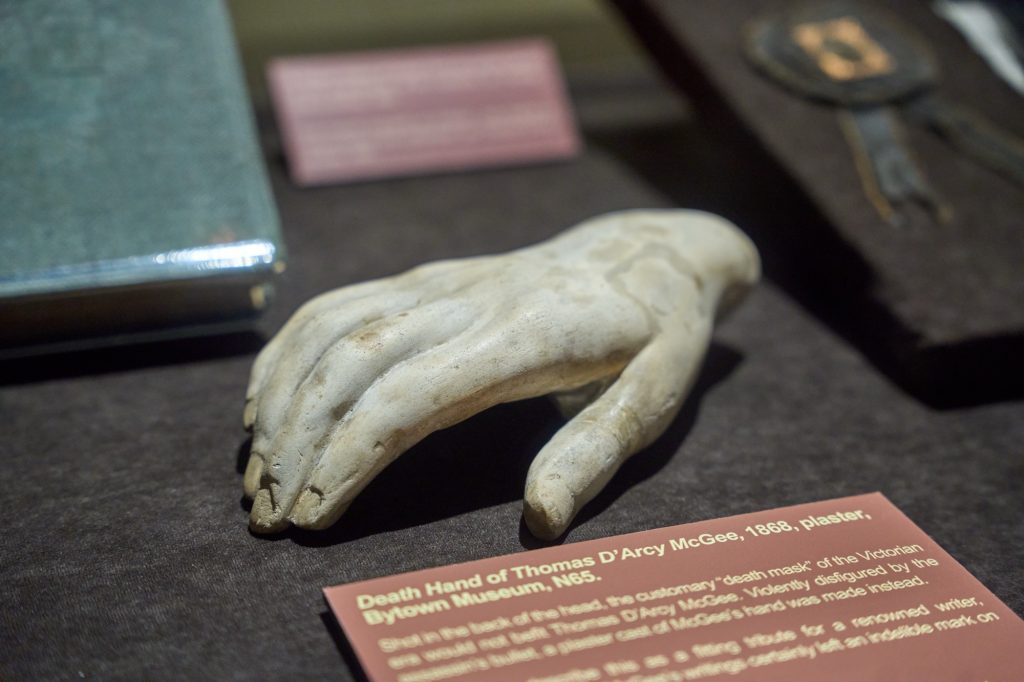
One of the museum’s most haunting artifacts belongs to Thomas D’Arcy McGee, a journalist, politician and Father of Confederation, who was assassinated outside his Sparks Street boarding house in 1868.
Because of the nature of his death, a traditional Victorian death mask could not be made. Instead, a cast was taken of his hand.
“It was fitting, as he wrote poetry, was a writer, and was a journalist,” Dennis said.
The permanent exhibition concludes with Ottawa’s wartime contributions, including stories of local nurses, soldiers and community groups during the South African War and First World War.
One particularly striking object is a small Bible carried by Ottawa soldier John C. Denmark. A bullet lodged inside its pages after striking the book in his pocket, likely saving his life.
Though the museum once focused almost entirely on Ottawa before the First World War, Dennis said its mandate has evolved in recent years better to reflect the city’s broader, more diverse history.
“We’re in a capital city, but we’re still a community museum,” she said. “So we try and focus on local history on a national stage.”