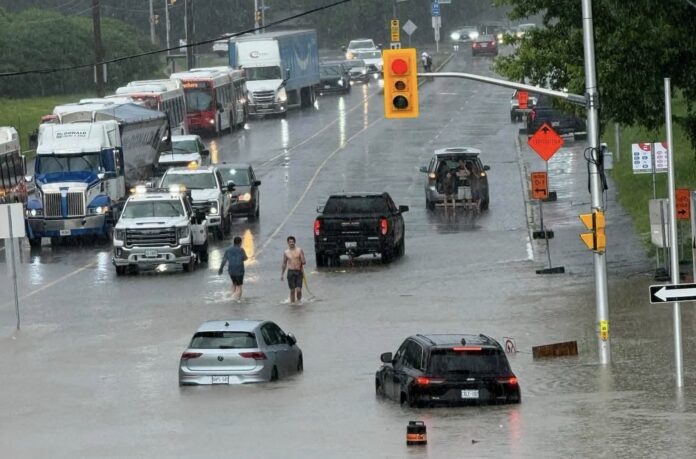

For many Ottawa residents, the damage caused by the Canada Day flooding is still fresh in their minds. Basements were destroyed, treasured belongings were lost, and some homeowners are wondering whether it could happen again.
In neighbourhoods such as Crystal Beach, Britannia, McKellar Park and parts of Carlingwood, the July 1 storm left behind more than damaged drywall and ruined furniture. It also raised serious questions about the city’s aging infrastructure and whether Ottawa is prepared for the increasingly severe weather events expected in the years ahead.
According to a City of Ottawa report released July 11, as much as 167 millimetres of rain fell in Britannia over approximately five hours, exceeding the threshold associated with a once-in-200-year storm. Nepean recorded 144 millimetres, while Colonnade received 151 millimetres.
The intense rainfall overwhelmed neighbourhood drainage systems, causing widespread basement flooding, road closures and power outages. While the city’s major water and wastewater facilities remained operational, local storm sewers and drainage systems were unable to handle the extraordinary volume of water.
Ten days after the rain stopped, Ottawa had received 5,423 storm-related service requests through 3-1-1, according to figures from July 10. College Ward accounted for 2,282, followed by Bay Ward with 1,512 and Knoxdale-Merivale with 684. The figures include flooding and other storm-related requests, rather than exclusively confirmed flooded homes.
More than 7,000 residents eventually reported basement flooding, according to subsequent reporting.
The topic has undoubtedly become a focal point of this fall’s municipal election, with residents eager to learn how the mayoral candidates would invest in infrastructure to strengthen it against whatever severe weather patterns may be in store.
Here’s what they’ve had to say.
Mark Sutcliffe promises climate-resilient infrastructure investments
Incumbent Mayor Mark Sutcliffe has pledged to prioritize $500 million in infrastructure over the next four years to help Ottawa withstand the effects of climate change.
The funding would be directed toward projects including storm sewer upgrades, ditch improvements, energy infrastructure and other measures intended to protect communities from extreme weather.
His campaign has promised to prioritize neighbourhoods affected by the July 1 flooding and other areas considered vulnerable to future storms, with investments guided by engineering assessments and expert recommendations.
Sutcliffe has also committed to a neighbourhood-by-neighbourhood review of the summer’s flooding to determine what went wrong and what infrastructure improvements are required.
In an interview with the Kitchissippi Times, Sutcliffe said he had spoken with affected homeowners and maintained regular contact with local councillors.
“We are doing an exhaustive neighbourhood-by-neighbourhood review of what took place on Canada Day and on other days where flooding occurred in August,” he said.
“We will analyze exactly what took place, because it wasn’t one thing that impacted all 7,000 residents in Ottawa who experienced flooding. There were different reasons in different neighbourhoods. And there’s different infrastructure in different neighbourhoods.”
Sutcliffe said those findings would help determine where future investments should be made.
“I’ve committed that whatever infrastructure improvements we need to make to protect residents from flooding in the future, we will make those investments,” he said. “So that will be prioritized as part of our infrastructure plans going forward.”
His campaign has not specified how much of the proposed $500 million would go specifically to Bay Ward or to the other communities affected by the July 1 storm.
The $500 million is also a broader climate-resilience commitment rather than a fund dedicated exclusively to flood prevention.
Sutcliffe has defended the city’s existing infrastructure investments, pointing to $94 million in climate-related capital contributions in the 2026 municipal budget.
Jeff Leiper proposes $50 million for the hardest-hit wards
Jeff Leiper, the current city councillor for Kitchissippi Ward, has announced a more geographically targeted approach, promising $50 million in infrastructure improvements in the Bay, College, and Knoxdale-Merivale wards.
His proposal would prioritize sewer repairs and other infrastructure upgrades intended to reduce the likelihood of future flooding.
Leiper has also promised to increase grants for affected homeowners, establish a dedicated team to help residents navigate insurance claims and relief programs, waive permit fees for flood-related repairs and increase 3-1-1 staffing during major emergencies.
But he has cautioned against assuming the cause of the flooding is already known.
In an interview with the Kitchissippi Times, Leiper said residents in Crystal Beach, Britannia and other west-end communities were facing serious financial consequences.
“We need to ensure that on a timely basis, we get the results back from the city’s investigation into what happened,” he said. “We don’t know. We don’t really know.”
“There are lots of guesses about what happened, but we need expert analysis of what happened before we can start to understand exactly what we need to fix.”
Leiper has also argued that Ottawa needs to invest more aggressively in preparing its infrastructure for extreme weather.
His broader platform includes a dedicated one-per-cent infrastructure levy to address the city’s backlog of road, bridge, sewer and other municipal repairs.
Leiper noted Ottawa already understands the need to prepare for increasingly severe storms, but has not adequately funded the necessary improvements. He has also criticized the city’s response to the July 1 flooding as too slow, saying he would have visited affected neighbourhoods earlier and more frequently.
Sutcliffe’s campaign has disputed that characterization, saying the mayor was in contact with emergency officials on the day of the storm and spoke with affected residents and councillors the following day.
Alex Lawson calls for sewer maintenance and emergency response review
Alex Lawson has focused his flooding proposals on examining how Ottawa maintains its existing infrastructure and responds to disasters.
The homebuilder and mayoral candidate has promised a street-by-street review of sewer maintenance records to determine whether the city has been adequately inspecting and maintaining its drainage systems.
He has also called for a review of Ottawa’s emergency response procedures, questioning whether the municipality is placing too much responsibility on volunteer organizations during major disasters.
Lawson previously served on the board of West Carleton Disaster Relief, which assisted residents affected by severe weather events.
In an interview with the Kitchissippi Times, Lawson said maintaining essential infrastructure should be among the city’s priorities.
His campaign has argued that the city needs a clearer understanding of where maintenance problems exist before determining which repairs and upgrades should take priority.
The proposed review would examine maintenance records across individual streets, potentially identifying areas where drainage systems have not received adequate attention.
Lawson has not announced a specific funding commitment comparable to Leiper’s $50-million plan or Sutcliffe’s broader $500-million climate-resilience proposal.
His approach instead emphasizes reviewing existing practices, improving accountability and ensuring Ottawa’s emergency response system is better prepared for future disasters.
Neil Saravanamuttoo wants nature-based solutions and sewer upgrades
Economist Neil Saravanamuttoo has proposed combining sewer infrastructure improvements with nature-based approaches to managing stormwater.
His platform calls for accelerating the replacement of aging sewers, prioritizing infrastructure investments in established neighbourhoods and introducing measures such as additional tree planting and stormwater retention ponds.
Saravanamuttoo has argued that Ottawa should focus more heavily on preventing flooding before extreme weather strikes.
In an interview with the Kitchissippi Times, he recalled speaking with a Crystal Beach resident who had watched floodwater rise inside his basement during the July 1 storm.
“They were flooded quite badly. In fact, he was describing that he was down in the basement with his dog, and they were literally watching the water rise. It would just be terrifying,” Saravanamuttoo said.
The resident, he added, had decided not to return belongings to the basement because of fears that another flood could occur.
Saravanamuttoo said the experience illustrated the storm’s lasting effects.
“It is, as you say, an infrastructure problem. And there are essentially two things at play here,” he said.
“Number one is we need to do better nature-based stormwater management systems. So whether that’s more trees, whether that’s reservoir pools that will catch water and hold it. There’s a lot that we can do above ground that will absorb a lot of that rainwater.”
He also pointed to the need to replace aging sewers and questioned why previous warnings about flooding risks had not led to greater infrastructure investment.
Saravanamuttoo claimed the city had identified flooding risks in areas such as Crystal Beach approximately a decade ago, but failed to act.
He has also criticized the city’s decision to direct significant capital funding toward projects such as Lansdowne Park rather than prioritizing infrastructure improvements.
His platform includes city-coordinated neighbourhood retrofit programs, which would help residents organize home improvements, access financing and apply for available federal incentives.