
By Iya Mendoza
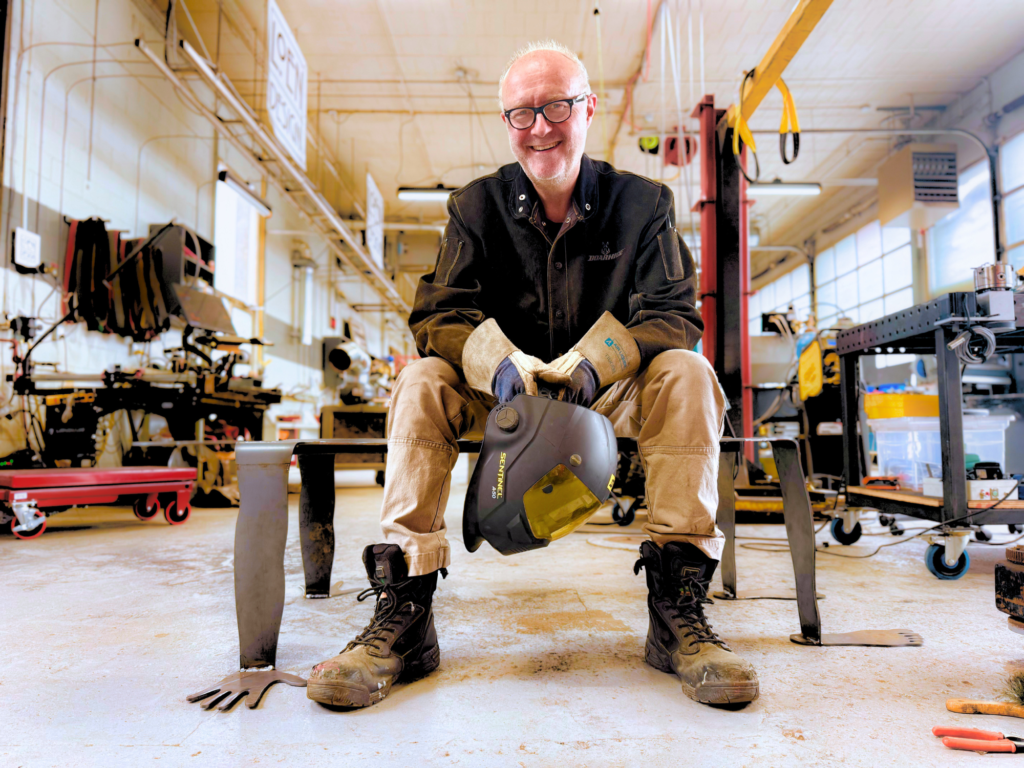
Rich Loen said he sat at home for just 20 minutes before getting bored after retiring. So when his career in engineering and software development came to a close in 2019, he decided to turn to his artistic side.
“I’ve always been the creative heart of the companies I’ve been involved in,” Loen said. “My mom’s an artist, my dad’s an artist, my brother’s an artist … I’ve always been into that kind of thing.”
For Loen, creativity had always been a family affair. While his professional career focused on technology, his artistic interests were never far behind. Retirement offered an opportunity to explore that passion in a new way, combining his background in engineering and design with a lifelong appreciation for art.
Loen was the owner of the Salone Des Bananes art gallery and Loen Design studio, located near Carling and Woodroffe avenues. Once home to a tire company, Loen purchased the building the same year he retired, transforming it into a space where art, technology and imagination could come together.
“I always walked by it to take my kids to play hockey … I was always looking at it,” he said. “I thought that’d be a cool place. And it has a fun sign out front.”
That sign had since become one of the most recognizable features of his studio.
Resembling an old theatre marquee, it featured a giant banana and a rotating collection of messages displayed in blocky black letters. Some were funny, others were thought-provoking, and a few were deliberately obscure.
“When I moved in, there was a box with all the letters and a stick with a suction cup on the end,” said Loen. “So I put up a message that said ‘HELLO WORLD.’”
“Every two weeks, I’ve been putting up different messages on the sign. It’s the longest-running art project I’ve ever done.”
The messages ranged from song lyrics and famous quotes to unusual facts and inside jokes. Some were universally understood, while others, Loen joked, might only make sense to “three people on Earth.”
But what began as a playful experiment took on deeper meaning during the COVID-19 pandemic, when the sign became a source of encouragement for passersby.
“I would put up messages like, hey, let’s all learn to play the banjo,” he said. “And I’d put up messages of hope.”
It wasn’t until the pandemic had passed that Loen realized just how meaningful those messages had become.
During his studio’s first show, visitors approached him to share how the sign had helped brighten their days during an otherwise difficult period.
“People would talk to me and say, ‘Through COVID, your sign was really important to me.’ And I would look at the person, and they had tears coming down their face,” said Loen. “Saying over and over again how important it was for them.”
“That’s an interesting thing, because it’s a sign with words on it. But it’s a piece of art.”
That same philosophy — that even the simplest creative gesture could have a meaningful impact — was at the heart of Loen’s newest project.
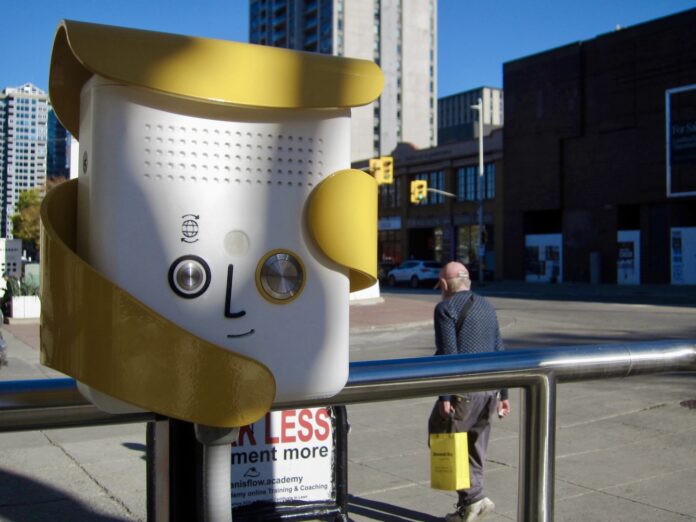
In June, his roadside sign temporarily became home to the Awesome Box, an interactive art installation designed to spread kindness through recorded messages.
With its bright yellow exterior, smiling face and shell resembling an embrace, the box invited strangers to share a little positivity.
“The idea was to bring a little bit of joy and a smile to people’s faces,” said Loen. “We’re at a time when kindness is important.”
The concept had been in development for some time, with Loen and his team experimenting with ways to combine technology, creativity and human connection. Once the design came together, they knew they had something worth sharing.
“We ended up building this great little thing,” he said. “Makers tend to make things because they’re cool. Artists tend to make things because they have a meaning.”
“The Awesome Boxes are kind of right in the middle of that.”
Following its initial test run, the project expanded to four locations across Ottawa: the Ottawa sign in the ByWard Market, the Ottawa Art Gallery, the Ottawa School of Art and the National Gallery of Canada, where the newest box was installed in October.
The expansion, Loen said, happened almost by accident.
Representatives from the Ottawa Art Gallery were visiting his studio when they noticed a couple of Awesome Boxes sitting nearby.
“They were like, ‘Those are cute, what do they do?’ So we explained that it’s just a box where you press a button and you hear nice messages,” said Loen. “And if you double-press the button, you get to leave a message.”
Not long afterward, the City of Ottawa approached the gallery looking for artwork for the ByWard Market that “was kind.”
“Then the OAG people came to me and said, ‘Hey, remember that Awesome Box?’”
The rest, as they say, was history.
At first, there were concerns about what people might record when given the freedom to leave anonymous messages. But Loen said the response had been overwhelmingly positive.
“People sing songs, people record little short messages, little kids come up and scream,” he said. “And other people record a whole 30 seconds of just a nice ‘I hope you’re doing okay, remember people love you.’”
“There were no instructions about the kind of messages to leave,” Loen said. “The messages are beautiful, uplifting. And it’s amazing to me. People just get it.”
For Loen, the project was about more than creating something interesting to look at. Like his roadside marquee, the Awesome Box demonstrated how art could connect strangers, spark conversations and offer encouragement when it was needed most.
What started as a small experiment had become a public reminder that kindness didn’t always require a grand gesture. Sometimes, it took little more than pressing a button and sharing a few thoughtful words.
Loen called the Awesome Box a “beautiful little success story.”
“(It’s) a kindness that we’ve created,” he said. “People are still able to appreciate kind things and do kind things.”