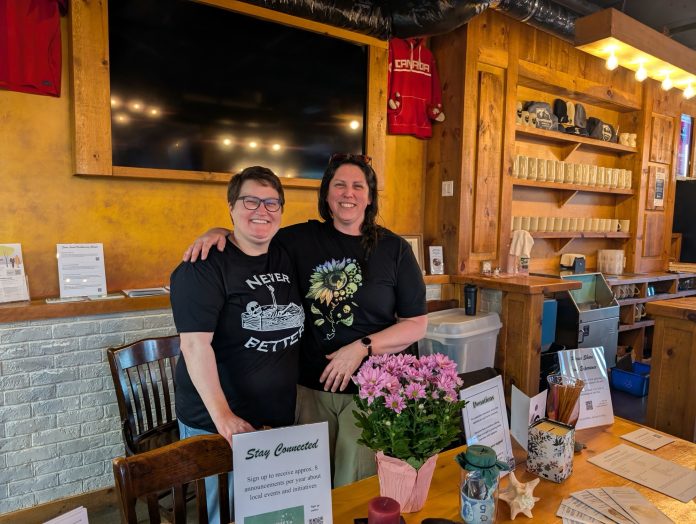

Curious conversations brewed at Braumeister Bierhalle on June 1 as Community Deathcare Ottawa hosted a Death Café (DC), a freeform discussion that invited people to eat cake while talking openly about death.
Swiss sociologist Bernard Crettaz launched the first Death Café in 1999 after his wife’s death.
Jon Underwood and Sue Barsky Reid later expanded the concept into a global “social franchise” in 2011. DC organizers Heather Martel and Hintonburg-born Michelle Olmstead both survived serious health scares and worked in end-of-life care.
Martel, an academic advisor at Carleton University and end-of-life counsellor, said her husband, who worked in body transfers, often shared stories about families caught unprepared after a death.
“People need to know before that moment in time,” Martel said.
“That’s how we got talking in the first place,” Olmstead, who runs Olmstead End of Life Care, explained. “We said the exact same thing. I wish there was a pamphlet.”
The literature “cre(m)ated” by Olmstead and Martel, Pocket Guide to a Monumental Undertaking, summarized care planning, wills and burial arrangements with a playful touch.
When a brain bleed forced Martel into surgery, more than a decade in end-of-life care helped her navigate the experience, though parts of it still blindsided her.
“Things I thought were in my tool box were not accessible… [but] there was no resistance in that process for me. I was like this is happening, so what am I going to do?”
Martel had a death box prepared that contained account information and her wishes.
“Once my death box arrived in the hospital room I felt a wave of relief,” Martel divulged.
Having a death box ready spoke to the importance of securing a death doula in advance, Olmstead said. When Olmstead experienced blood clots, she did not have Martel’s experience or planning.
“I didn’t know where to go or who to talk to. It is an interesting contrast,” Olmstead observed. “I was so disconnected from the fact that I almost died, I didn’t even realize what was happening. It wasn’t until the doctor said you should be dead right now. That didn’t register. That made me consider my own mortality.”
Having led Ottawa DCs since 2018, Martel remembered cafés in funeral homes and hospices.
Community Deathcare Ottawa eventually absorbed the DCs in what Martel described as a “natural” merger. She said the events provided a casual setting for conversations about death.
“It’s not sombre. It’s a bunch of strangers getting together and talking about this one thing they have in common.”
Defne Oksit, research coordinator for the Division of Palliative Care at the Bruyère Health Research Institute, attended the DC to recruit participants for a study on repetitive transcranial magnetic stimulation (rTMS) to alleviate symptoms of prolonged grief disorder. rTMS is a non-invasive brain stimulation technique that delivers powerful magnetic pulses to brain areas responsible for mood.
The study involved participants receiving up to eight rTMS stimulations per day for five consecutive days on the top of their head.
“Attending an event like DC allows us to connect with the community who may be in search of such treatments that may not be as accessible, not always as free or not always as heard of,” Oksit said.
Born in Turkey, Oksit noted differences in how societies dealt with death, saying Turkish “post-death practices” are “collectivist” while in North America we are more “individualistic” when “commemorating a loved one.”
Oksit found DC to be “ an intriguing, open-ended discussion with people exploring nuanced perspectives on death and dying”, admitting she “didn’t know what to expect at first.”
“I showed up as a professional persona but once the conversation started going I started to get out of that shell and wanted to share,” Oksit said. “It is interesting to hear what different reasons brought people here. That interaction and that dichotomy of what people might be experiencing, but at the end we are all here. I thought that was really valuable.”
“North end Preston Street” resident Matthew Pearson said the DC opened his eyes to conversations about death in a different way.
“I thought it was a surprisingly intimate and thoughtful conversation with the people at my table, none of whom I had met before,” Pearson said. “It was quite a moving experience.”
Pearson is the author of Grief Café, a chapbook inspired by the death of his mother.
“The zine is a combination of poetry and prose as well as blank space for the user to think about their own reflections around body, mind and soul,” Pearson said. “Think about how you would reorder your life after a profound loss.”
Martel likened the conversations at DC and preparing for death to planning a vacation.
“I hope it inspires people to look ahead to the inevitable and understand that it is never too early,” Martel, known as “the death lady” in some circles, said. “What I hope this accomplishes is people thinking about it and talking about it ahead of time, normalizing the conversation and feeling more comfortable to shoot the shit about dying and death.”
To participate in the Bruyère study email doksit@bruyere.org