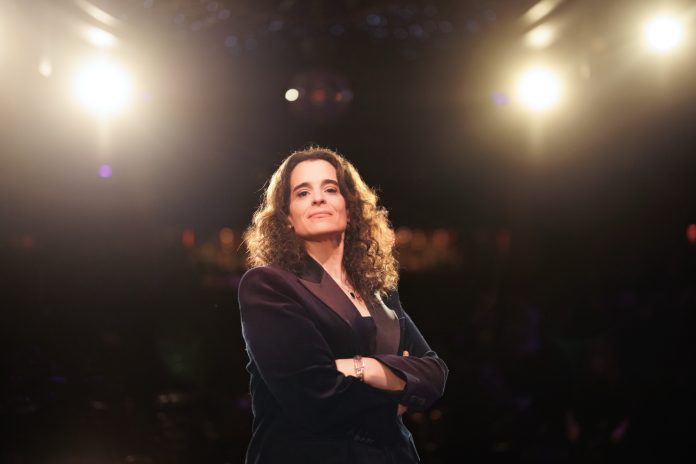

The lights are low inside New York’s Comedy Cellar, the brick walls close enough to feel like they’re leaning in on the joke. A man in the front row shifts in his seat as Jessica Kirson steps up to the mic, squints into the crowd and locks onto him..
“How are you?” she asks, tilting her head. “You look uncomfortable.”
The room tightens. The man laughs nervously. Kirson doesn’t let him off the hook. Within seconds, she’s diagnosing his denial, playfully unravelling whatever energy he walked in with. Then she pivots — zeroing in on another cluster of guests.
“Are you a couple?” she asks. It’s one of her regular introductory lines. She starts interrogating them on how they met, what they do for a living, and their sex life.
For Kirson, the stage isn’t a platform for rehearsed monologues — it’s a live wire. She has built a career on crowd work, mining the audience for material. She also regularly pokes fun at herself — her Jewish upbringing, her sexuality as a lesbian, and her mental health.
In May, that unpredictable energy is headed north when she brings her razor-sharp improvisation to Ottawa’s Bronson Centre — and if her New York sets are any indication, the capital’s front row might want to brace itself.
“I do the kind of comedy where people are entertained the whole time. They don’t have to think too much. It’s very fast-paced. I do a lot of characters, I do audience stuff, and talk to them a lot,” Kirson told the Kitchissippi Times.
The description is understated.
Kirson has amassed hundreds of millions of views across social media platforms. Long before algorithms amplified her reach, she had already established herself as a staple of the New York comedy circuit, performing regularly at the Comedy Cellar and touring nationally. She has appeared on The Tonight Show with both Jay Leno and Jimmy Fallon, been a guest on The View, and is a contributor on the Howard Stern Show.
Despite always knowing she could make people laugh, Kirson began in a much more serious profession: social work. It was a fitting start: her mother was a therapist who treated clients in the family’s New Jersey home, meaning Kirson grew up around conversations about behaviour and vulnerability — skills that now serve her well on stage.
“I wasn’t really happy doing that, because it was very hard for me to see what was happening to people and hear about it. I was always sad,” said Kirson. “My grandmother told me that I should do stand-up, because she was telling me how I have always made poop people laugh.”
The rest is history.
Early days were hard. She performed in small clubs, often late at night, sharpening her timing in rooms that could turn cold in seconds. She pulled inspiration from her comedic role models such as Robin Williams.
“I used to watch him, and I was always amazed at what he did because so much of it was improv and on the spot. That’s a lot harder,” she said.
That elasticity — the ability to shapeshift mid-sentence — became her signature. She regularly goes through people’s bags on stage, once performed a “gay gospel song,” and will ask any question that comes to mind. Comedy isn’t meant to be a sensitive topic, she said. But there are still some areas off limits.
“I don’t talk about politics because I don’t think it’s funny. There are also certain things I don’t talk about because it would just be at the expense of other people or other groups of people. I know how far I can go. It comes from experience and also just reading the crowd,” she said.
Kirson performs at the Bronson Centre at 7:00 p.m. on May 22.
“I really hope that people come to let go for an hour and a half and just laugh and not think about difficult things they are going through and what’s going on in the world,” she said.