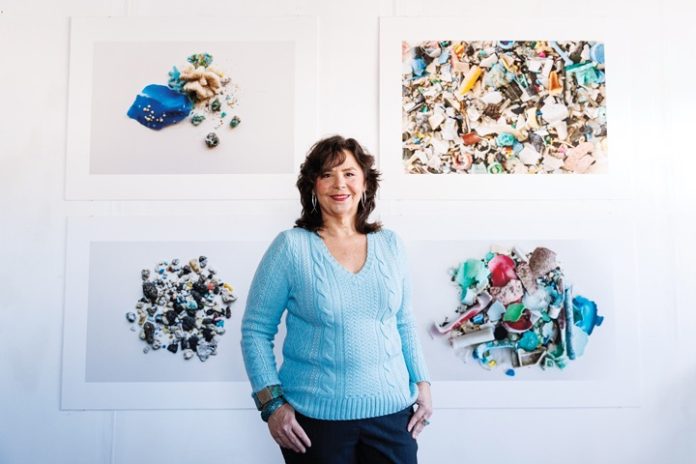

Some may view art and science as mutually exclusive but Hintonburg-based artist Cindy Stelmackowich has crafted a career combining her two passions.
These interests mirror those of historic Central Experimental Farm (CEF) botanist Faith Fyles, and Stelmackowich co-curates an upcoming exhibit detailing Fyles’ life and work at the Ottawa Art Gallery opening March 7.
As an art student who straddled the artistic and scientific disciplines, Stelmackowich says her electives were subjects like cell anatomy and biochemistry.
“I was not the typical art student,” she laughs.
When choosing a masters thesis as a PHD student at Binghamton University, Stelmackowich met an art historian who specialized in realism and “talked about the visual cultures of science in an interesting way.”
Her chosen topic, nineteenth century anatomical atlases, with Gray’s Anatomy being a notable example, were initially produced after dissection became legal in Europe and visual representations were required for training.
“There were also big portfolios, some of them life sized, of the inside of the body. I was finding them in medical archives, both in North America and Europe. I realized no one has done an in-depth analysis of the visual imagery. They will talk about the history of Grey and maybe use one or two pictures as illustrations but they weren’t really analyzing the art.”
Stelmackowich’s disaster series combines nineteenth century atlas drawings superimposed with images of disasters. One triptych from this series is featured in the Canada Council Art Bank collection.
Drawn to the beauty of the atlas images, Stelmackowich notes they are brightly coloured, lacking blood and fat, and looking like “superhero bodies.” The faces can be expressive and the hair is often coiffed. She describes this as “fake realism” as that was the type of realism the profession needed at the time.
Concurrently during the time period when the first atlases were illustrated the industrial revolution began in North America. There were massive ship wrecks, gas explosions in cities, and fires in anatomical medical theatres.
“It hit right for me,” Stelmackowich says. “There is the hygienic beautiful body but inside there are these disasters going on. If you know someone going through trauma or a hard time their body is kind of sickened as well. It’s their physical anatomy, not just in the brain,” Stelmackowich explains.
“It was a way for me to see art and science as a reflection of the culture. It is constantly shifting. Just when we think there are universal norms, it is shifting and having to prove itself, and reprove itself. Then a whole new set of truth comes out. That was the way I was picturing art and science.”
Born in Cowansville, Quebec in 1875, Faith Fyles pioneered the combination of art and science. Fyles studied botany before becoming a seed analyst at the Department of Agriculture in 1909. Fyles joined the CEF in 1911 and eventually headed the arboretum.
In 1920, she became the first artist employed by the horticulture department where she painted many water colours, notably depicting the harvests of apples and raspberries. The book Principal Poisonous Plants of Canada is solely attributed to Fyles.
Presented by the Ottawa Art Gallery in partnership with Ingenium: Canada Science and Technology Museum, the exhibit includes specimens from the Canadian Museum of Nature, the CEF Herbarium and Archives, and Canada’s Royal Botanical Gardens.
In addition to Fyles’ illustrations the exhibit includes pressed plant specimens and the tools of early botany, “to tell her wider story of how she did what she did” Stelmackowich explains.Co-curator William Knight, Ingenium’s curator of agriculture and fisheries, says this is the first time there has been a retrospective exhibition dedicated to Fyles as an artist who worked as a botanist.
“These are two very distinct roles” Knight says. Many of Fyles’ works depict apples as orchards were once a prominent feature of the CEF.
“They are standard paintings showing an apple in vertical format, on the upper portion it’s the apple in a whole, and below it’s cut through. We wondered why this form. Imagine a huge orchard blossoming in the spring. It’s kind of recovering a lost feature of the CEF’s landscape through Fyles’ apple paintings. There are other types of works in the exhibition but there is going to be a real focus on the apple.”
Co-curated by OAG’s Rebecca Basciano and Meghan Ho, the exhibition will also feature art by Marie-Jeanne Musiol, Barbara Brown, Deborah Margo, Stephanie Tenasco, and Susan Geraldine Taylor.
As a expert on Fyles’ work, Knight praises Stelmackowich’s contributions to the project.
“She is knowledgable about women in science, gender and representation. She brings all that skill to the project,” Knight says.