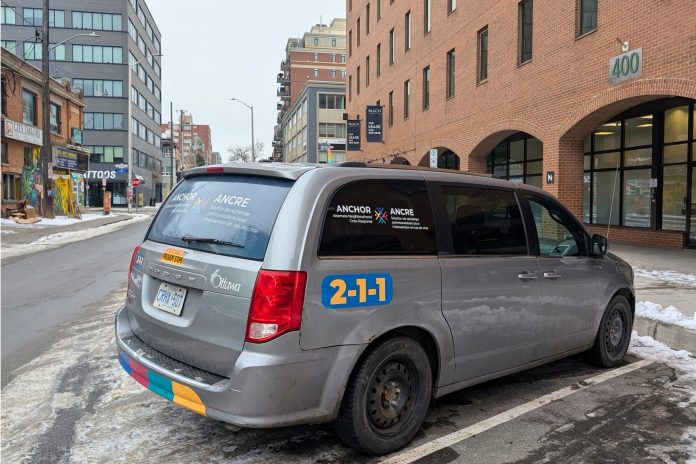

The Alternate Neighbourhood Crisis Response (ANCHOR) is the City of Ottawa’s new answer to a long-reported social crisis. One year in, data shows the experiment is working.
Launched on August 15, 2024 in collaboration with the Community Navigation of Eastern Ontario (2-1-1) as well as the Centretown and Somerset West community health centres, ANCHOR is a 24/7 police alternative. Calling 2-1-1 contacts ANCHOR’s mobile community-based team which is specifically equipped to handle mental health and substance use crises.
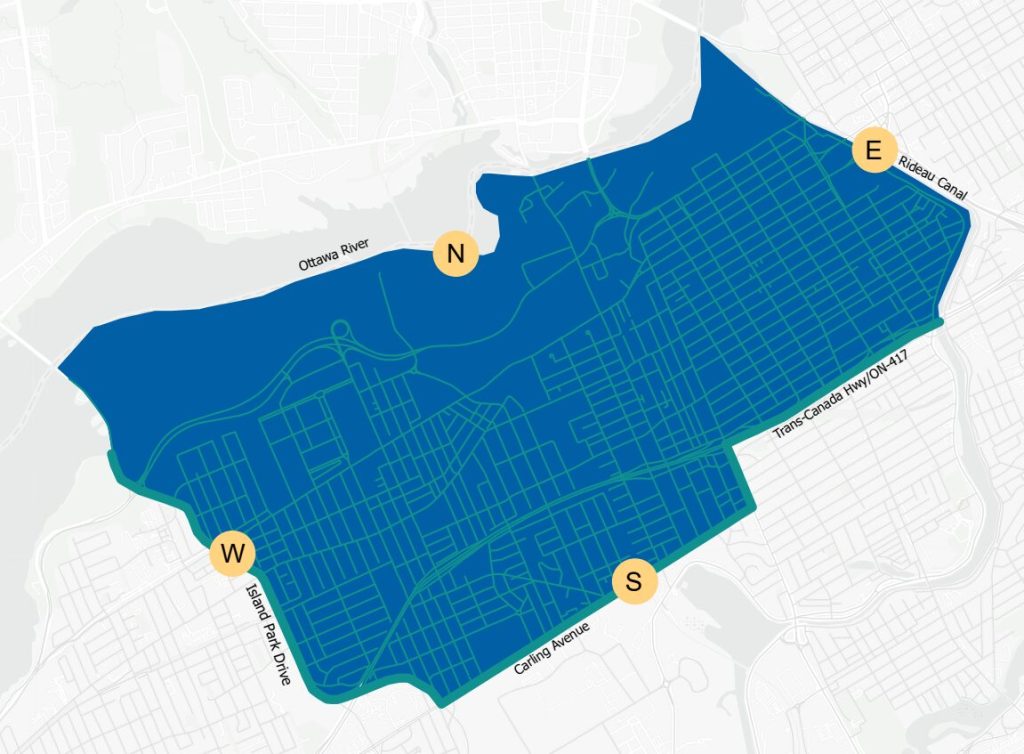
Initially, the ANCHOR program’s catchment was mostly limited to Centretown. But the city approved the program’s first expansion on Nov. 13, extending its reach westward from Preston Street to Island Park Drive and south from the Queensway to Carling Avenue.
“It’s worked from a lot of different perspectives,” said Centretown Community Health Centre’s (CCHC) director of Mental Health, Caroline Cox. “We knew that this was a community need, but the call volume was higher than even we had anticipated.”
In just its first year of operation, the program received 4,464 calls, 92.7 per cent of which were calls made directly to ANCHOR.
“I think that it also shows that people have an appetite to call the community for help and not even go through 9-1-1,” Cox said.
The remaining 7.3 per cent were calls transferred from Ottawa Police. ANCHOR has proven that not every crisis needs to be a 911 call.
“People know, and they know anecdotally as well when we talk to them; they can recognize when someone is not committing a crime,” Cox said. “It’s not a criminal justice issue, but they need help.
“We need to be sending the most appropriate resource to a situation.”
Calling 2-1-1 during a social crisis triggers a notably different procedure from a 9-1-1 dispatch, where the ANCHOR team brings a variety of de-escalating factors and techniques to respond to a situation.
As CCHC’s director responsible for ANCHOR, Cox said the program’s approach – without lights and sirens, without police uniforms or weapons – already goes a long way to alleviate the typical stressors that might compound a mental health crisis or social situation during a typical police response.
“We’ve also been very intentional in our hiring that we want to hire people from a diversity of cultural, religious, racial, linguistic backgrounds,” Cox said. “And so if someone can speak your language or looks like you, that also starts to decrease the anxiety.”
Coming from a variety of professional, educational and lived experiences, the ANCHOR staff bring skillsets for suicide prevention, de-escalation, motivational interviewing and more to calm a victim and connect them to appropriate social resources across the city.
“Our teams are highly networked, so they kind of start going through their mental rolodex,” Cox said. “We’ll provide transportation if folks need it, we’ll provide some practical assistance like food or water or warm clothes.”
While the program launched in the summer of 2024, there have long been public calls for an alternative to police response.
According to Cox, local activism for that cause ramped up after the death of Abdirokman Abdi, a Somali-Canadian man with mental health struggles, following his violent Hintonburg arrest in July 2016.
She said the city finally committed toward a solution with the Black Lives Matter movement’s global surge in 2020 following the murder of George Floyd by police in Minneapolis, Minnesota. Shortly after, in 2021, the Ottawa Police Services Board established the Guiding Council to research alternatives to police response.
In June 2023, the City approved an initial $2.465 million in funding for the alternative response program which would materialize as ANCHOR one year later.
While no small fee, it’s remarkably little for a service that looks to be an alternative to police response. Compare that sum to the Ottawa Police Service’s operating cost of $414.9 million in the 2026 Draft Budget, an increase of $26.1 million.
When an Ottawan calls 2-1-1 as opposed to 9-1-1, it saves city money and police resources. In its first year, 92 per cent of ANCHOR calls were conducted without police intervention.
Moreover, in the program’s first year, only 3.8 per cent of calls required paramedics and 3 per cent ended up in a hospital emergency room. In fact, 52 per cent of all ANCHOR calls were fully resolved over the phone.
“Either they’re diverting away from a more costly resource or they’re accessing a resource where they would have accessed none before,” Cox said. “So either way you look at that data, I think it’s a win.”
Data shows the ANCHOR program has proven itself as a successful alternative to police response. Cox attributes much of that to the team’s empathetic approach.
“If you’ve ever supported someone in a mental health crisis or you’ve been through one yourself, you know that people need to be treated with dignity and respect and compassion and met where they are,” Cox said. “I think people deserve that, but I also think that if you don’t meet people there, you’re going to get more resistance.”
But the reality of this early experiment is that 2-1-1 is not an accessible service to much of Ottawa’s footprint. Even with its Nov. 13 expansion, ANCHOR’s reach will remain limited, at least for now.
“I think there’s a lot of indicators that point to the fact that it needs to be city wide,” Cox said. “I know from conversations with the city that’s their desire as well. It’s just a matter of how we make that happen.”
Until then, ANCHOR will continue to operate as a 24/7 alternative to police response in its second year with an expanded Centretown catchment area, making effective use of its uniquely empathetic approach.
“That approach is what people deserve,” Cox said. “But it’s also what works in terms of de-escalating and not escalating a crisis.”