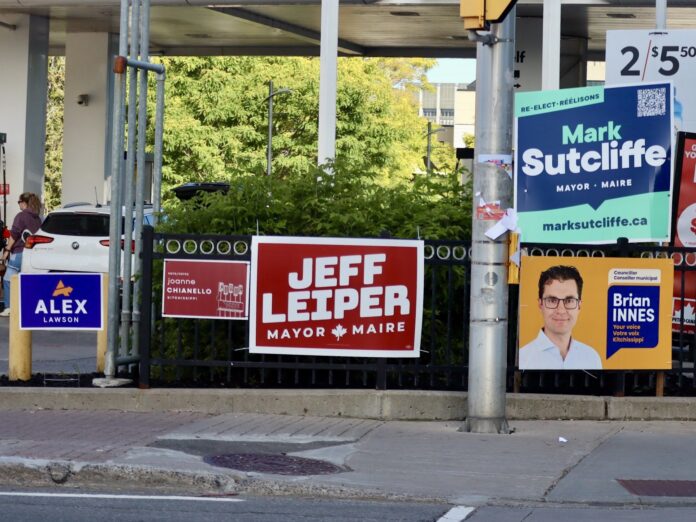

From the growing towers of Westboro to the bustling storefronts of Wellington West and ongoing community safety concerns in Chinatown, Ottawa’s next mayor will have plenty of decisions to make that could shape the future of local neighbourhoods.
As residents head to the polls on Oct. 26, the city’s four leading mayoral candidates — incumbent Mark Sutcliffe, Kitchissippi Coun. Jeff Leiper, homebuilder Alex Lawson and economist Neil Saravanamuttoo are offering differing visions for Ottawa’s future.
Here’s how some of their commitments could affect voters in the Kitchissippi Times catchment area.
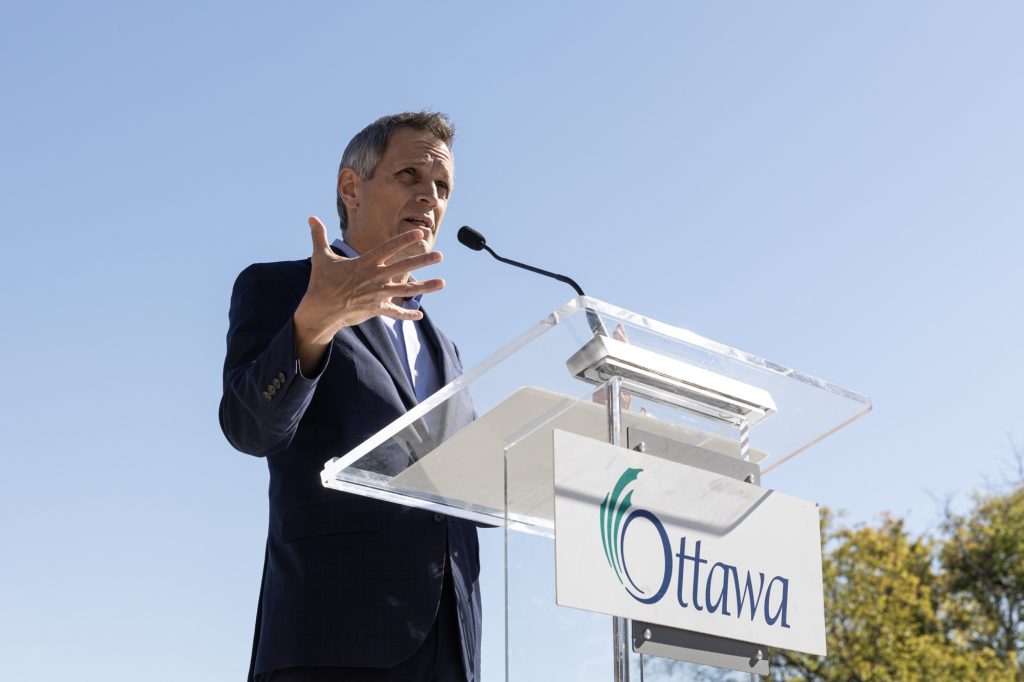
Mark Sutcliffe announces Kitchissippi business plan and Carling bus lanes
Just three days before voters headed to the polls, Sutcliffe announced a series of neighbourhood-specific commitments, including a proposed Kitchissippi Business Improvement Plan.
The initiative, announced during a press conference at Mooney’s Bay Beach on Oct. 23, would see the city work with local business improvement areas to improve traffic flow and increase parking options. Sutcliffe also pledged to work with developers to incorporate publicly owned parking into new infill developments.
The announcement did not include details about the plan’s cost, timeline or where additional parking might be created. It comes after the introduction of paid parking along portions of Richmond Road and Wellington Street West in September 2025, a decision that generated considerable debate among residents and businesses.
“For the past four years, I’ve worked hard to be a Mayor for all of Ottawa,” Sutcliffe said in the campaign announcement. “A one-size-fits-all approach doesn’t work. Every part of our city is distinct, and our priorities must reflect that.”
His broader platform includes permanently eliminating municipal fees for patios, parkettes and café seating, potentially benefiting restaurants and businesses throughout Westboro, Wellington West and Chinatown.
On transit, Sutcliffe has proposed continuous bus lanes along Carling Avenue between Lincoln Fields Station and Sherwood Drive. The plan isn’t new and has been in the works for over a decade. Bay Ward Coun. Theresa Kavanagh previously said progress was delayed due to safety studies and priority being given to the Baseline bus rapid transit project.
Sutcliffe has also pledged to reduce the monthly OC Transpo adult pass from $138.50 to $95, introduce a $10 daily fare cap, and improve service reliability.
To improve community safety in areas such as Chinatown, Sutcliffe has proposed a rapid neighbourhood cleanup program to address discarded needles, garbage and other hazards. His platform also calls for activating the city’s Emergency Coordination Centre to coordinate responses to homelessness and addiction, while targeting businesses he describes as “pill mills” through licence revocations.
Sutcliffe has also promised to appoint a Downtown Safety Czar to coordinate efforts to address public safety concerns in the urban core. His broader platform includes hiring 200 additional police officers, 100 paramedics and 50 firefighters over the next term.
Development is another issue Sutcliffe has addressed in Kitchissippi, where high-rise construction has transformed portions of Richmond Road and Scott Street, as well as areas surrounding LRT stations.
“We have to build around public transit and around major routes without upsetting the character of local neighbourhoods,” Sutcliffe told the Kitchissippi Times. “And I know Kichissippi has carried a lot of the weight of intensification over the last few years.”
His platform calls for approving at least 75,000 additional homes by 2030, including 10,000 affordable, supportive and transitional housing units.
Jeff Leiper promises to restore transit and address neighbourhood concerns
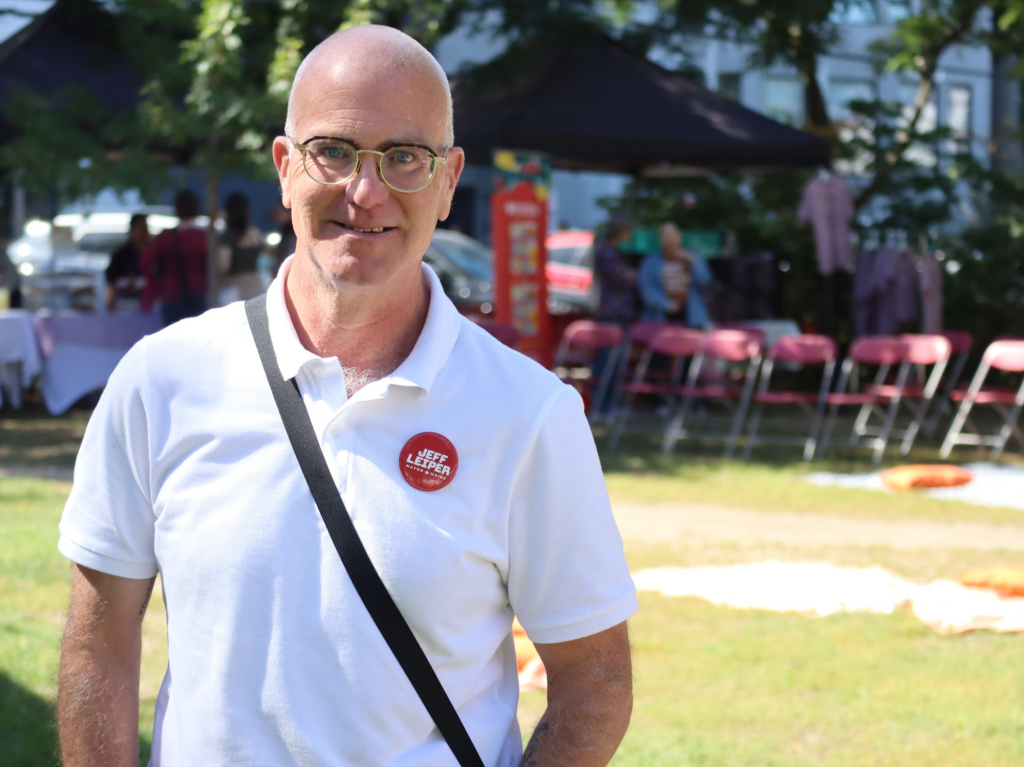
Leiper is no stranger to the Kitchissippi area, having served as its city councillor for the last 12 years. While there have been no direct campaign announcements related to his current ward, the municipal politician has made transit reliability, affordable housing, and neighbourhood livability central to his campaign.
“We continue to hear a lot about transit,” Leiper told the Kitchissippi Times during an interview about his campaign. “We hear a lot about green space and trees in Kitchissippi, so intensification has had the result of significant tree loss and tree canopy.”
Leiper has promised to reverse recent OC Transpo service reductions and introduce a Transit Service Guarantee, which would establish publicly reported standards for reliability and frequency.
He has also pledged to restore approximately 70,000 hours of bus service eliminated through OC Transpo’s New Ways to Bus overhaul and purchase additional buses to improve reliability across the network.
Leiper has specifically identified service reductions affecting Westboro and neighbouring communities.
“We have in Hintonburg, where I live, the city’s best transit, but when you move forward to Westboro, we lose one of our best routes,” he said. “The frequency of the 11 has been diminished. The 14 continues to be cancelled morning after morning.”
Community safety has also become an increasingly prominent issue, particularly in Hintonburg, where residents have reported concerns about public drug use and social disorder.
“I heard from a resident recently in Hintonburg who is afraid to walk her daughter to school at Devonshire because of the public drug use and the social disorder that she’s seen on the street,” Leiper said. “Very few people are comfortable with it. It diminishes their feeling of security in their neighbourhood. It has to be addressed.”
Leiper wants more outreach workers, street ambassadors, and needle-collection crews, alongside permanent funding and an expansion of ANCHOR, Ottawa’s alternative crisis-response program.
His housing platform includes an acquisition fund that would allow non-profit organizations to purchase existing rental properties and preserve affordable housing. He is also promising 1,500 new non-profit homes annually, with support from other levels of government.
On intensification, Leiper supports concentrating taller buildings near rapid transit stations, mid-rise developments along main streets and lower-rise housing within established residential neighbourhoods.
He also wants to update neighbourhood planning documents to provide greater clarity about what can be built.
Alex Lawson would eliminate paid parking
For Westboro and Wellington West residents frustrated by the introduction of paid parking, Lawson has made one of the campaign’s most direct promises.
The homebuilder has pledged to eliminate paid on-street parking across Ottawa, switching off parking meters on his first day in office and eventually removing them.
His proposal would also establish a minimum two-hour parking limit wherever time restrictions are necessary.
The change could have an immediate impact on commercial districts along Richmond Road and Wellington Street West, where paid parking has become a contentious issue over the past year.
Lawson has argued that parking fees discourage people from visiting local businesses. His broader platform also proposes increasing the small-business property tax discount from 15 to 25 per cent.
But parking is only one part of his campaign, which has largely focused on improving municipal services and addressing aging infrastructure.
“We have to make sure that we are doing what is expected and needed by the residents of the city,” Lawson told the Kitchissippi Times.

He has emphasized maintaining roads, sewers and other essential infrastructure, arguing that the city needs to prioritize basic services and better manage existing assets.
On transit, Lawson wants OC Transpo to rebuild schedules using operating data and driver input, reconsider routes that require unnecessary transfers and restore temporary peak-hour express buses until the Confederation Line meets specified reliability standards.
Lawson has also proposed a 90-day review of Ottawa’s shelter system, including unannounced inspections, public performance scorecards and an independent ombudsman.
His proposal would require shelters to report assaults, thefts and police calls, while tracking complaints and discarded needles in surrounding neighbourhoods. The measures could have implications for communities such as Chinatown and Centretown, where homelessness and public drug use have become prominent concerns.
On housing, Lawson has promised to cut development charges by 50 per cent for one year to encourage construction, particularly family-sized rental units.
His campaign has set targets of approximately $1,800 per month for new two-bedroom rentals and $2,200 per month for three-bedroom homes.
Neil Saravanamuttoo wants to expand public housing
For communities like Kitchissippi and Somerset that are experiencing rapid intensification, Saravanamuttoo has proposed allowing more development-related revenues to remain in the neighbourhoods where growth occurs.
The economist and first-time candidate has argued that urban communities should receive more direct benefits from new development, particularly when additional residents place pressure on aging infrastructure, parks and public services.
“What I’m proposing as mayor is that the communities that are absorbing growth, a lot of the development revenues associated with that growth should stay in the community to fund the upgrades that the community needs, whether that’s hard assets, like sewers, or whether that’s parks or something else,” Saravanamuttoo told the Kitchissippi Times.
His platform would earmark certain development revenues for local improvements and introduce participatory budgeting, allowing residents to vote on some neighbourhood capital projects.
On transit, Saravanamuttoo is promising a major redesign of OC Transpo’s bus network, with more frequent service along high-demand corridors, additional neighbourhood routes and the potential return of some express buses.
He has also proposed reducing conventional transit fares to $1 per ride, with a $40 monthly cap.

Saravanamuttoo hopes to fund the fare reductions through savings generated by transferring responsibility for Ottawa’s LRT infrastructure to the provincial government, although such an arrangement would require Queen’s Park’s approval.
“We are running a lot of legacy routes. We’re running a lot of routes that are just always empty, and we need to go back to square one on this and have a process with riders, with operators and with people that want to be riders,” he said.
Housing affordability is another central part of his campaign.
Saravanamuttoo wants to expand publicly owned, mixed-income rental housing, with a long-term goal of increasing non-market housing from approximately five to 10 per cent of Ottawa’s housing stock.
On homelessness and addiction, Saravanamuttoo has pledged to expand ANCHOR citywide, introduce rapid-response teams to clean up needles and biohazards, and improve access to detoxification and recovery services.
His platform also includes mobile health clinics, transitional housing and additional daytime spaces for vulnerable residents.
“We cannot hold out for the perfect solution,” Saravanamuttoo said when discussing his proposed transitional housing model. “We need to go with something good enough. And this is more than good enough.”
With files by Brian Dryden