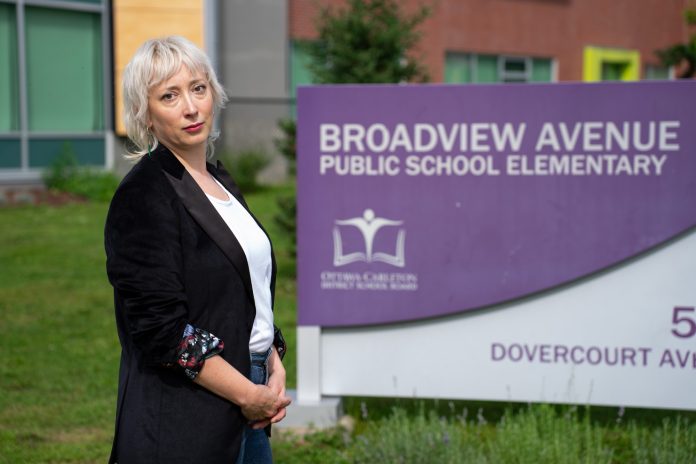

Two candidates with different views on the challenges facing Ottawa’s largest school board are vying to represent Kitchissippi and Bay wards this fall.
Emily Quaile and Benoit Massé are running for Ottawa-Carleton District School Board trustee in Zone 4. But whoever wins will take on a job that looks considerably different from what it did when voters last went to the polls four years ago.
The OCDSB has been under provincial supervision since June 2025, when Education Minister Paul Calandra stripped elected trustees of their decision-making authority and appointed Robert Plamondon to oversee the board.
The intervention followed a provincially ordered financial investigation that found the OCDSB had reported in-year deficits since 2021-22 and exhausted its reserves. Its accumulated deficit stood at $5.9 million at the end of 2023-24.
There is no firm date for the restoration of local control, meaning voters will elect trustees this October without knowing when — or to what extent — they will be able to govern.
For Quaile, that uncertainty is part of the reason she decided to run.
The Westboro resident is a mother of two young children and a longtime service-industry worker who holds two bachelor’s degrees and a master’s degree in political economy.
She said her decision to run was partly shaped by her own experience as an OCDSB student.
“I went to five different OCDSB schools during the Bob Rae and Mike Harris years when I was a student in Ottawa. Those years were marked by exceptionally deep cuts to different programs and school closures, and I found myself bouncing around chasing the programs that I needed to succeed academically,” said Quaile.
Quaile said one of her priorities would be to push for an end to provincial supervision and to restore a stronger role for locally elected trustees.
Under supervision, Plamondon currently exercises the powers normally held by the elected board, including authority over its finances, policies and governance.
Quaile described running for trustee under those circumstances as applying for “two different jobs” — one while the supervisor remains in place and another if local governance is restored.
“The first job is going to focus a lot on ensuring that the province and board know that supervision is not the way to go,” she said. “We need proper, clear democratic channels to have our voices heard.”
She said she has heard from parents struggling to obtain support for students with individual education plans, or IEPs, and other specialized needs.
The debate over local decision-making has been particularly visible in the past year due to the OCDSB’s controversial Elementary Program Review.
Trustees approved the overhaul in May 2025 after months of public debate. The plan would have changed boundaries and programming across the district, resulting in thousands of elementary students potentially changing schools.
Plamondon cancelled the sweeping changes after taking control of the board, citing the disruption they could cause students and families. The board has instead moved toward more localized accommodation and boundary reviews.
Quaile said she was pleased the larger overhaul did not proceed, but believes it was an attempt to address a much broader problem.
“The EPR was a bit like rearranging the chairs on the Titanic,” she said. “I’m really glad that we aren’t fussing with those chairs anymore, but we do need to do something about the sinking ship that we’re still trapped on. That requires calling a spade a spade, calling out the underfunding as the core problem/“
Quaile said her background in political economy and more than 20 years working in the service industry have shaped how she views public education and government spending.
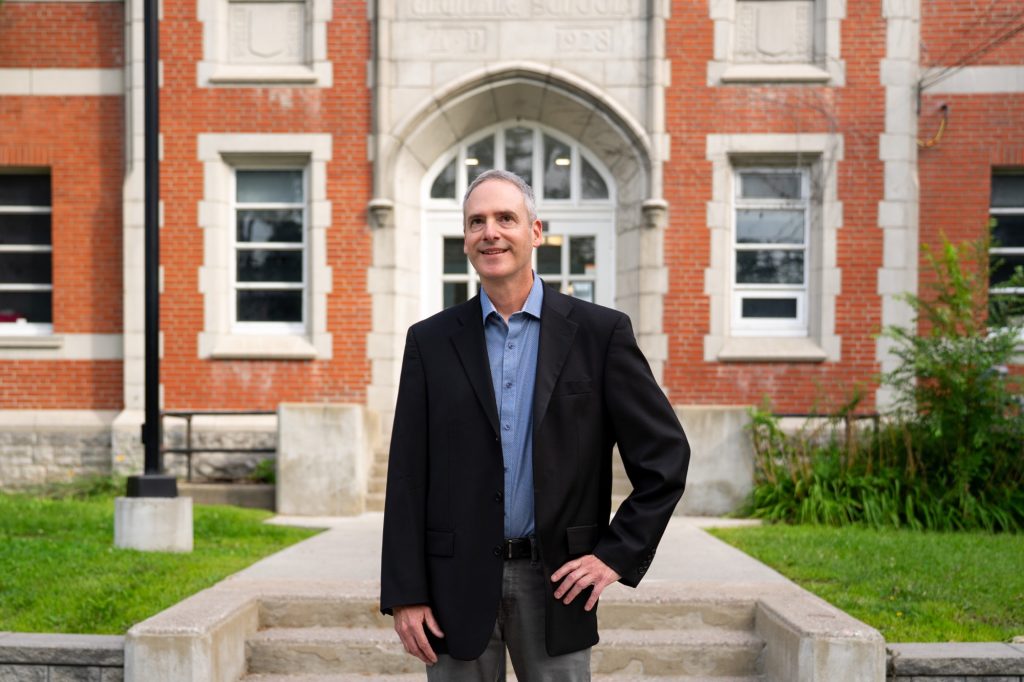
Massé, meanwhile, is approaching the board’s challenges from a financial perspective.
A Westboro resident and father of a nine-year-old student at Elmdale Public School, Massé is a chartered professional accountant who works for the federal government and has served on the Elmdale school council.
“My strength is my background in finance and accounting,” Massé said. “I saw that our OCDSB is under control from the Ministry of Education, so I think I could make a difference or help whenever the control goes back to the trustees to make sure that we are on target with the budget.”
Massé said restoring financial sustainability would be one of his priorities, alongside student safety, addressing bullying and harassment, and improving communication between trustees, parents and educators.
“I spend some time with the teachers, and I see all the difficulties. I’m also with the Elmdale school council, so that helped me to understand all the different issues that are affecting the students,” Massé said. “I think it was the next step for me to go from the school council to the school board.”
The OCDSB’s finances have been a central issue since provincial supervision began.
The Ministry of Education found the board had reported in-year deficits since 2021-22 and depleted its reserves. Its financial position has since improved, with the OCDSB’s 2026-27 budget projecting a $3.5-million operating deficit, following the identification of approximately $15 million in savings.
Massé said he would need to examine the board’s finances in greater detail before determining where savings could be found.
“I don’t have the data to see how I can help, but something for sure, whatever we can allocate back to the student, I agree with that strategy,” he said.
He also acknowledged there is considerable uncertainty about how much authority the trustees elected this fall will actually have.
The province has not announced when supervision will end. Massé said his priority, whenever authority is eventually returned to trustees, would be ensuring the board does not return to its previous financial position.
Massé also said he wants the next group of trustees to put greater emphasis on the board’s finances.
“Not focus too much on social activists, which I think the previous trustees were involved, but really rather focused on the budget, on sustainability,” Massé said.
Massé was born in Montreal and has lived in Ottawa for roughly 27 years, including the past four in Westboro. He holds a master’s degree in business accounting and said his experience on school council motivated him to become more involved in the community.