
When Cara Vaccarino arrived in Ottawa to take over as president and CEO of The Royal in early 2024, something about the city’s mental health system surprised her.
For an institution dedicated to treating some of the region’s most complex cases of mental illness and addiction, there was no straightforward way for someone experiencing a crisis to walk through its doors and ask for immediate help.
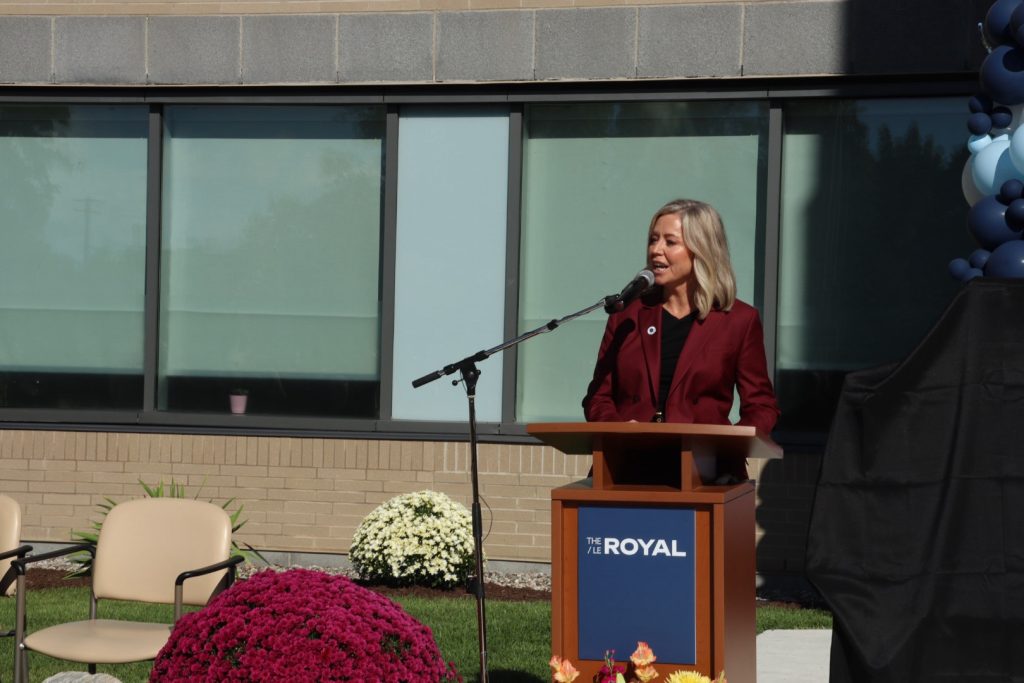
“I was very, very surprised that there was no direct access to The Royal’s mostly inpatient services, which is a flow-through to outpatient care as well,” Vaccarino told KT. “Honestly, it’s not rocket science. It’s just common sense. When you have an organization that’s really difficult to access, you sort of unpack why, and basically, we had no direct admission route to The Royal.”
Vaccarino and her team at The Royal set out to change that. More than two years later, their work has resulted in a first-of-its-kind service in eastern Ontario.
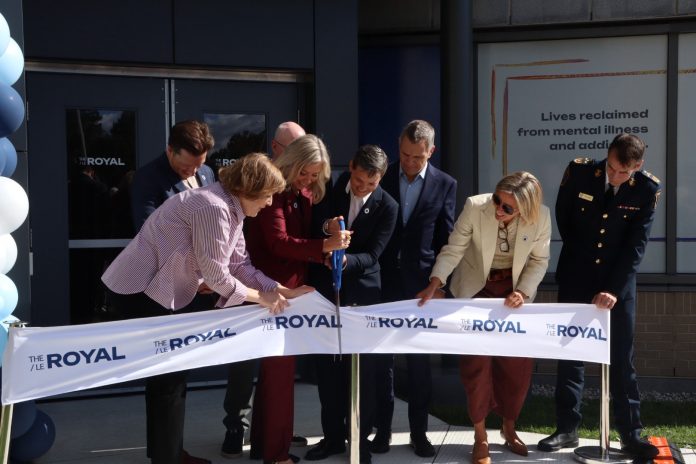
On Sept. 18, staff, politicians, donors and community members gathered outside The Royal’s Carling Avenue campus to cut the ribbon on the Minto Greenberg Urgent Care Clinic. It opened its doors to patients three days later.
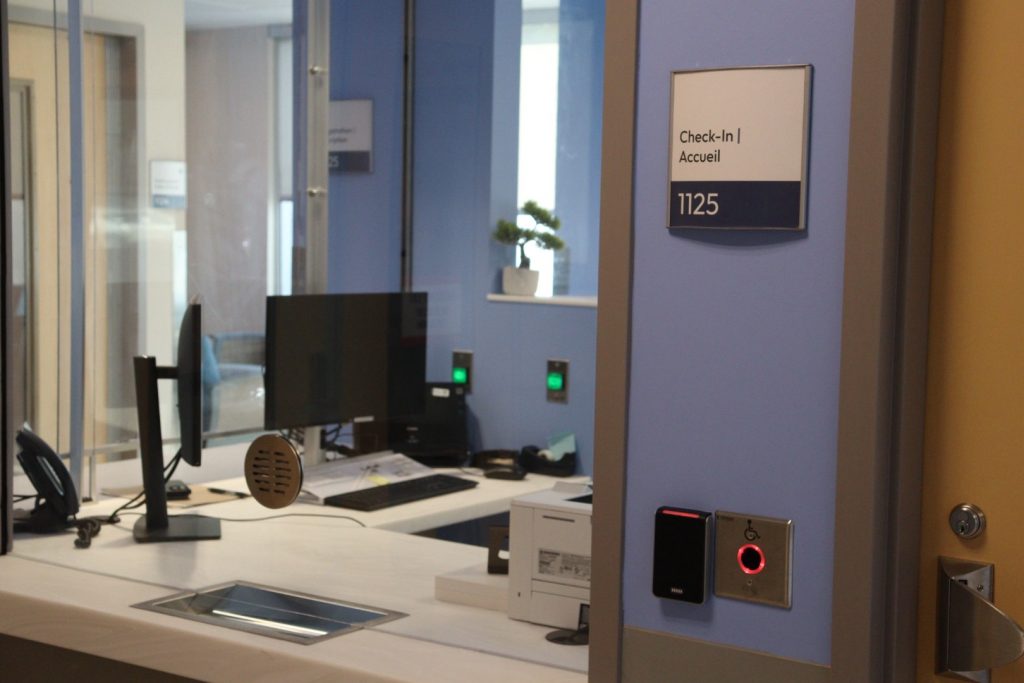
The clinic allows adults experiencing an urgent mental health crisis to walk into The Royal without an appointment or referral and receive specialized psychiatric care.
Resorting access taken away decades ago
In some ways, the new urgent care clinic is going back to a model which worked in the past.
During the late 1990s, the Ontario Health Services Restructuring Commission ordered significant changes to hospital care across the province. In Ottawa, that restructuring led to the creation of The Ottawa Hospital in 1998, bringing together several existing institutions and services.
Psychiatric emergency services at the Royal Ottawa Hospital were transferred to the newly amalgamated Ottawa Hospital, and its emergency department shuttled in 2000. While it was supposed to improve efficiency, Vaccarino said the Royal became “isolated and cut off from being a really impactful partner in the health-care system in Ottawa.”
The new urgent care clinic is not a recreation of that emergency department.
Instead, it fills a space between scheduled mental health care and the traditional ER. It is intended for people whose psychiatric symptoms have become too serious to wait for their next appointment but who aren’t experiencing a life-threatening physical emergency.
“We’re looking at — relative to other jurisdictions — very high emergency department wait times across the city of Ottawa, and the urgent care clinic at The Royal will be a really excellent way to help people divert from going to the emergency departments, which are really overburdened with unprecedented demand,” Vaccarino said.
“It will also be a really good support for primary care practitioners across the area — family doctors who really manage a lot on their own, but when they need help with really complex, acute or confusing patients, they need access to specialized mental health assessment and treatment.”
A study by researchers at The Ottawa Hospital and University of Ottawa examined more than 170,000 visits to The Ottawa Hospital’s emergency departments between May 2022 and April 2024—about nine per cent ended with patients leaving before being seen by a physician.
The study was not specific to psychiatric patients, but Vaccarino said people experiencing mental illness face particular challenges in busy emergency departments, where patients with urgent physical conditions are prioritized.
“Those environments are really unsettling for people with serious anxiety or depression or substance use disorder or paranoia or some degree of psychosis,” she said.
The Royal began a soft launch in April, initially accepting referrals from local emergency departments. By September, more than 200 individual patients had used the service, accounting for roughly 600 visits.
Vaccarino said an analysis of those early patients found about 65 per cent were experiencing suicidal ideation or thoughts of hurting themselves.
Stephanie Carter, executive director of clinical services at The Royal, said the early experience demonstrated the seriousness of the cases arriving at the clinic.
“The people coming through our doors have often been experiencing severe symptoms and significant risk, including thoughts of suicide. This team has met each person with kindness and has provided exceptional clinical care,” Carter said.
“We have carefully evaluated the impact of this early work, and the results are clear. Symptoms improve, risk decreases, and people leave with the support they need. I can say with confidence that this team has already saved lives.”
The clinic now accepts walk-ins, referrals from local emergency departments, transfers from the Ottawa Paramedic Service and drop-offs from Ottawa Police Service Mobile Crisis Response Teams.
For first responders, Vaccarino said, that can mean spending less time waiting at a hospital with someone experiencing a psychiatric crisis.
“Ottawa Police and Paramedics are super excited because they spend many hours just waiting with patients before they can offload them from ambulance or police carriers, and that ties up our emergency first responders unnecessarily across the region,” she said. “When they come to The Royal, they can just drop them off and wave goodbye, and we’ll take it from there.”
How it works
The Minto Greenberg Urgent Care Clinic is located at 1145 Carling Ave., with its own exterior entrance beside The Royal’s main doors.
It currently operates Monday to Friday from 8 a.m. until 4 p.m. and is open to adults 18 and older. No referral is required. Patients are first assessed to ensure there is no physical health emergency requiring treatment elsewhere.
Patients can then be seen by a multidisciplinary team that includes psychiatrists and other physicians, nurses, social workers, and peer support workers. Depending on the patient’s needs, care can include psychiatric assessment, crisis counselling, medication adjustments and assistance navigating other health services.
People with alcohol- or opioid-related concerns can also be connected to The Royal’s Rapid Access Addiction Medicine Clinic for specialized addiction treatment.
The urgent care clinic can generally accommodate about 20 patients per day. There is no charge for patients with a valid Ontario health card.
But the service doesn’t necessarily end after that first visit. If longer-term treatment is required, patients can be connected with specialized programs at The Royal or services elsewhere in the community. The goal is ultimately to stabilize patients and, where possible, return their ongoing care to family physicians and other community providers.
Then, if a client’s condition worsens again, the clinic remains another place to turn.
“Mental illness is cyclical,” Vaccarino said. “You have good days, you have bad days, you can go months feeling really well, and then you hit a wall and need some help again. So we need to really accommodate our mental health ecosystem according to the nature of these illnesses.”
The clinic was made possible in part through a $2.5-million donation from the Minto Greenberg Legacy Foundation.
It is also among the initiatives supported by The Royal’s Lives Reclaimed campaign, which has a $75-million fundraising goal to improve access to specialized mental health and addiction treatment and to advance care and research.
The campaign launched with a $14-million gift from the Waverley House Foundation.
Vaccarino hopes the clinic will soon be able to expand its services into evenings and weekends. She expects the increased care to happen soon.
“Evenings and weekends are when other services are closed, and police and paramedics are really needing someplace that they can bring people for support,” she said.
She acknowledged the financial pressures facing hospitals across Ontario, but said they cannot become a reason to stop changing how care is delivered.
“What if we all just threw up our arms and said, ‘There’s no money, we can’t do it?’ Well, that’s not acceptable. And I don’t think it’s true,” Vaccarino said. “I think you can always do something better, and you should always try if you’re going to be in this line of work. That’s our calling. That’s our job.”
With files by Rory Haley