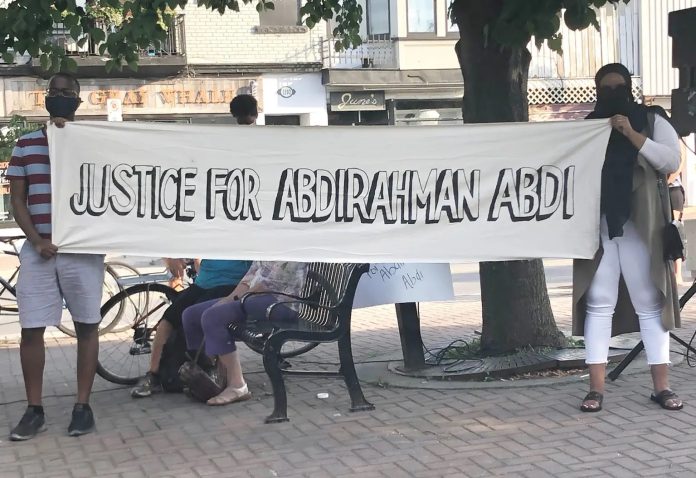

Ten years after Abdirahman Abdi died following a violent encounter with Ottawa police, advocates say many of the reforms recommended in the aftermath remain unfinished, raising renewed questions about how officers respond to people experiencing mental health crises.
Abdi, a 38-year-old Somali-Canadian man, died in hospital on July 25, 2016, one day after an encounter with Ottawa Police Service officers outside his Hintonburg apartment building.
His death galvanized Ottawa’s Somali and Black communities and became a rallying point for calls to reform police responses to mental health crises, use-of-force practices and systemic anti-Black racism.
A decade later, Ifrah Yusuf, chair of the Justice for Abdirahman Coalition, says that work is far from over.
“The Ottawa Police Service has a lot of work to do to fully implement the recommendations that were set forth by the inquest,” Yusuf told KT. “We see a lot of the recommendations still in progress — none are considered fully implemented.”
The coalition was formed following a town hall meeting held by Ottawa’s Somali community in the days after Abdi’s death. Yusuf, who attended that meeting, says its calls for change remain relevant 10 years later.
A death that sparked calls for change
Abdi emigrated from Somalia in 2009 and settled in Hintonburg, where he found work at a local car wash.
On July 24, 2016, police were called to the Bridgehead coffee shop at Fairmont Avenue and Wellington Street West after reports that a man was groping women in and around the coffee shop.
Abdi left and was followed to his Hilda Street apartment building, where two officers attempted to arrest him. During the confrontation, Const. Daniel Montsion struck Abdi several times. Abdi lost vital signs and was transported to hospital, where he died the following day.
Montsion was later charged with manslaughter, aggravated assault and assault with a weapon. He was acquitted on all charges in 2020.
A mandatory coroner’s inquest into Abdi’s death began in November 2024, more than eight years after he died. The jury classified his death as a homicide — a finding that, in the context of an inquest, does not assign criminal or civil responsibility.
The jury determined Abdi’s cause of death was a combination of post-cardiac arrest brain injury following blunt-force trauma and physical exertion, with underlying coronary artery disease contributing.
A psychiatrist who reviewed the case testified that Abdi’s behaviour that day was characteristic of someone experiencing schizophrenia. His family and health-care providers had confirmed he was experiencing hallucinations and symptoms of psychosis.
The inquest produced 57 recommendations, including 28 directed specifically at OPS, calling for changes to mental health crisis response, training, data collection and accountability, while addressing anti-Black racism and biases toward people experiencing mental illness.
Lawrence Greenspon, the lawyer who represented Abdi’s family during the inquest and in a civil lawsuit against the city, says the shortcomings the recommendations sought to address were hardly new.
“It should have been painfully evident that they were dealing with somebody who had mental health issues — that became one of the focuses of the inquest. Systemically, there has been, for the longest time, a problem with the police’s ability to respond to people who have mental health issues,” said Greenspon.
Greenspon says he has met with the last four police chiefs, who have shared statistics showing that 75 to 90 per cent of calls the OPS receives involve people who are experiencing mental health crises.
“The average police officer responding to the call simply doesn’t have the training to be able to handle the situation,” he continued.
OPS points to changes — but advocates want more
Ottawa police say work is underway to respond to the inquest’s recommendations.
The force has pointed to its Mental Health C.H.A.N.G.E. Initiative, which brings together police and community partners to improve interactions with people experiencing mental health crises.
The OPS said the initiative has been meeting since September 2025 “to focus on providing advice and recommendations that improve police interactions.”
The force has also increased staffing in its Mental Health Crisis Unit, which works with The Ottawa Hospital’s Mobile Crisis Response Team.
“As a result of the increased staffing and operational restructuring, joint responses have increased from an average of approximately 250 annually to approximately 450 annually,” the statement read.
The unit has trained 50 officers in crisis intervention. OPS has roughly 1,600 sworn officers.
For Greenspon, that is insufficient.
“Whatever percentage that is — if it’s two per cent, or I don’t know — but it’s not enough and it’s not reflective of the recommendations that were made by the jury,” said Greenspon.
“If the majority of their calls are dealing with mental health, then the officers need to have the training. Officers are doing a very difficult job … if they don’t have the training, it’s a recipe for tragedy,” he continued.
OPS also began a body-worn camera pilot in November 2025 involving members of its Crisis Intervention Team and selected officers in response to recommendations from the inquest.
But Yusuf says community trust remains shaken and wants greater transparency about OPS training.
“What concrete changes have been made in their use-of-force curriculum, training and definitions in order for our communities to feel safe around them?” said Yusuf. “It would build more trust if they were more transparent with their programs.”
Another change has occurred outside the police service.
The city’s Alternate Neighbourhood Crisis Response program, known as ANCHOR, launched in August 2024 as a 24-hour community-led alternative for certain mental health and substance-use crises. The Abdi inquest later recommended OPS continue referring suitable mental-health calls to the program.
In its first year, ANCHOR received 4,464 calls. Of 1,874 calls where crisis workers were dispatched, more than 92 per cent were handled without police involvement.
Yusuf says the coalition has advocated for approaches similar to CAHOOTS — Crisis Assistance Helping Out On The Streets — an Oregon-based mobile crisis intervention program where crisis workers and medical personnel can respond to appropriate calls without police.
“Another aspect is race-based training. We want to see the police being trained on racial sensitivities and cultural sensitivities,” said Yusuf. “Ottawa is a very diverse city, with people from all walks of life. Something that would also be very important is for the [training] curriculum to be mindful of that.”
The inquest similarly called for training incorporating anti-Black racism, intercultural competency and trauma-informed approaches.
The coalition has also created a post-secondary bursary awarded twice a year to “students who identify as Black, who are active in their community and are passionate about social advocacy.”
A decade after the meeting that brought the coalition together, Yusuf says community support has helped sustain its work.
“The community has been standing by us, and it means a lot. It shows that the work is meaningful and resonates with folks in Ottawa,” said Yusuf.