
By Reilly Armstrong
The first thing visitors notice inside Close to Conflict – Canada and the American Civil War isn’t an artifact. It’s the sound.
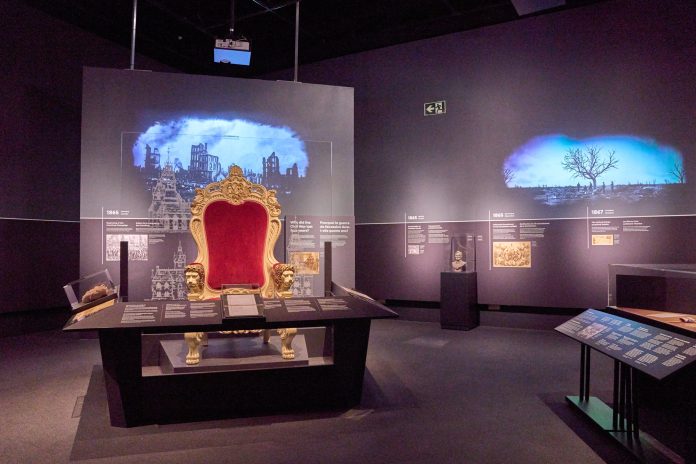
Slow horns, strings and soft piano notes drift through the Canadian War Museum gallery, layered with waves lapping against a shoreline, trains rumbling over tracks, birdsong, distant gunfire and the steady rhythm of marching boots.
Dark walls, dim lighting and muted carpeting complete the atmosphere, creating a lingering sense of unease. Even before reading a single display panel, visitors are transported to the 1860s, when the American Civil War unfolded just beyond the border of the British North American colonies that would eventually become Canada.
Behind that carefully crafted experience are two Kitchissippi residents.
Creative developer Claire Champ and lead exhibition designer Kerry McMaster Wassenaar helped bring to life one of the Canadian War Museum’s newest major exhibitions, exploring Canada’s complex relationship with a conflict often viewed as an exclusively American story.
“That’s the type of feeling that we wanted to have…that idea of movement and energy,” Champ told KT. “Potential menace far on the horizon without being so uncomfortable that you drive visitors out of the space.”
For Champ, who has worked in Canadian museums for more than 20 years and has called Wellington West home since 1999, creating memorable visitor experiences has always been central to her work.
“I feel really fortunate that I’ve always been able to work in museums,” she said. “I’m just really fascinated by what visitors experience in exhibitions.”
That fascination helped shape Close to Conflict, which invites visitors to explore how profoundly the American Civil War influenced the people, politics and communities north of the border.
Working alongside the museum’s exhibition team and hundreds of contributors and collaborators, Champ and McMaster Wassenaar set out to tell a familiar story from a distinctly Canadian perspective.
“As an exhibition designer, you’re always thinking about how people move through a space and what they’re feeling as they do,” said McMaster Wassenaar.
McMaster Wassenaar has also spent more than two decades working in museums. She grew up in Kitchissippi, where she once delivered newspapers for Newswest. Today, as lead exhibition designer, she transforms historical research and ideas into physical spaces visitors can experience.
“I’m responsible for sort of… figuring out what’s the physical manifestation of all the ideas, and how are they going to look? How is it going to feel?” she said.
Their goal was to create an exhibition that felt rooted in the era without feeling distant or inaccessible.
The carefully layered soundscape played a key role. McMaster Wassenaar said she drew inspiration from the opening theme of House of Cards, aiming for something she described as “political, threatening, but not too threatening.”
Collaboration was equally important to the project.
Champ said the museum relied heavily on historians, knowledge keepers and community members whose lived experiences helped shape the exhibition’s stories and interpretation.
“It’s really best practice in museums now to co-create and to share authority,” she said.
“For many visitors, it’s a much more authentic experience to bring those first-person voices of community members, community representatives, external experts.”
The exhibition is organized around a timeline tracing the Civil War along the gallery’s perimeter, with five central thematic zones. The first and final sections were fully co-created with outside partners, including Black historians Shannon and Bryan Prince, who helped develop the section exploring the Buxton community and the experiences of Black Canadians connected to the Underground Railroad.
Champ said their guidance added greater depth to the story, highlighting the community’s resilience while acknowledging the racism and barriers its members faced.
“They really brought that nuance,” said Champ. “As Canadians, we have to acknowledge that that’s also part of our history. We weren’t just the idyllic end of the Underground Railroad.”
Their contributions influenced everything from interpretation and object selection to the way difficult histories were presented.
The museum also worked closely with Dr. Linda Manyguns, a Blackfoot elder and knowledge keeper, whose guidance shaped the exhibition’s final section, exploring the Civil War’s lasting legacy and its connections to Indigenous histories.
“She really wanted to talk to visitors directly and kind of bring them into the integrity and vitality and richness of Blackfoot culture before colonialism,” Champ said.
Among Dr. Manyguns’ contributions are a buffalo hide for visitors to touch, traditional Blackfoot children’s powwow regalia, and other cultural objects.
“To be able to work with them and then have them see it and for them to think… this is my story and for them to resonate with it, that’s, you know, absolutely a big part of the reward,” said McMaster Wassenaar on the exhibition’s co-collaborators.
Running through the exhibition is a common thread: legacy.
Visitors can sit at an interactive table and hear descendants of Buxton settlers read their ancestors’ words aloud. Elsewhere, displays emphasize the enduring strength of Blackfoot culture, reminding visitors that history is not confined to the past but continues through living communities.
“There is a very human significance to all these stories,” said Champ. “I know (in) that exhibition… We cover a lot. We ask a lot of visitors. But I think they’re trying to show that these historical events are not just isolated in the past – they have a contemporary significance.”
The exhibition has also opened at a moment when Canada’s relationship with the United States is once again under the microscope. Amid ongoing political uncertainty, trade tensions and tariffs, Close to Conflict offers visitors historical context for conversations that still feel remarkably current.
“This is something that the museum’s been thinking about presenting for a while,” said McMaster Wassenaar.
“This idea of threat coming from south of the border – it resonates a little bit more, but I don’t think that we planned it to coincide with that,” said McMaster Wassenaar. “I think that was a little bit coincidental.”
Close to Conflict – Canada and the American Civil War is on display at the Canadian War Museum until Feb. 28, 2027.
“What I love about museums is I think they often show us the best parts of humanity,” said Champ. “I think it’s the idea of the fundamental connectedness of humanity.”