
The roar of Highway 417 is never far away in Hampton Park. Cars stream past the forest edge at all hours, commuters cutting across Ottawa’s west end while dog walkers circle the paths below and children splash in the wading pool nearby. At first glance, it feels like any other busy urban park folded into the fabric of the city.
But a few steps beyond the baseball diamonds, the landscape changes. The air cools beneath a dense canopy cover, some trees older than Confederation itself. Towering trunks block out much of the light overhead while layers of shrubs and saplings crowd the forest floor.
In the middle of one of Ottawa’s most urban neighbourhoods sits what advocates say is the city’s only remaining old-growth forest.
Located in the west end, the Federal District Commission purchased Hampton Park — now the National Capital Commission — in 1927 for $40,000 with the intent of preserving green space in a growing Ottawa. The original land package covered 42 acres and, before the sale, served as both a wood lot and a recreational area.
Nearly a century later, the park’s remaining 10 hectares contain ball diamonds, a dog park and community gathering spaces. But it is the forest itself that has become its defining feature.
Sharon Boddy, a researcher, writer and advocate for urban natural areas, has spent much of her life exploring the woods there. She’s been nicknamed the “chief cook and bottle-washer” of Hampton Park and knows its trails, canopy layers and ecosystems intimately.
Boddy says the woods meet the definition of an old-growth forest.
“The definition of an old-growth forest is that it has to have trees over 100 years old, it has to have shrubs and an understory layer. We have 200-year-old trees – so this qualifies.”
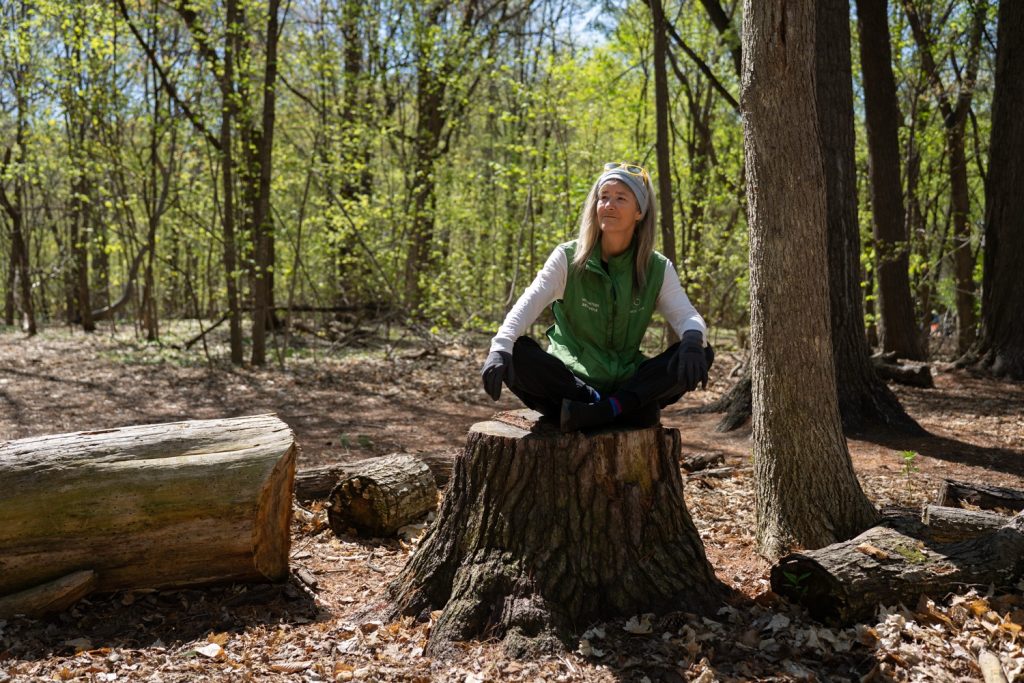
“It may only be 10 hectares, but look at the diversity we’ve got,” said Boddy.
Walking through the forest, Boddy points out the layered ecosystem that helps define old-growth environments. Hemlocks line a walking path along the east side while white spruce, beech and sugar maple stretch overhead. Below them, dense shrubs and native plants form a rich understory that supports birds, insects and wildlife.
That layered structure is exactly what volunteers are now trying to strengthen.
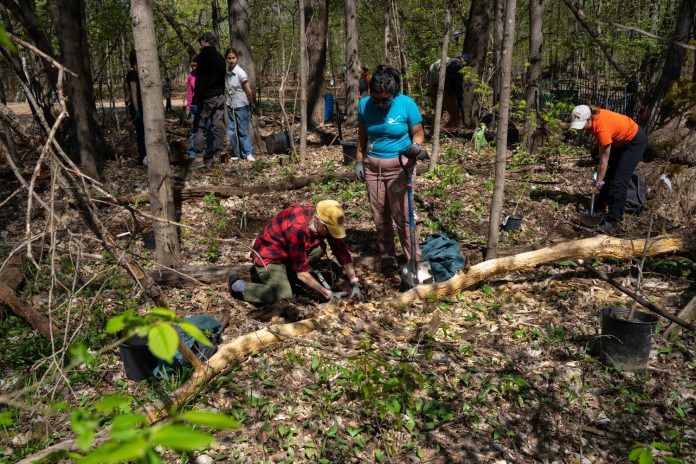
On May 9, Forêt Capitale Forest, the NCC and Friends of Hampton Park — a volunteer group Boddy founded in 2019 — planted native, non-invasive species throughout the park to help support the long-term resilience of the forest canopy ahead of the park’s centennial anniversary in 2027.
Jody Newman, afforestation program manager with Forêt Capitale Forest, said the event was both practical and educational.
“Today we partnered with the National Capital Commission and Friends of Hampton Park to plant 100 trees and 100 shrubs in the park, and we did a planting demonstration for everyone to show them how to plant a tree properly,” said Newman.
“A big part of our mission is enhancing biodiversity and tree canopy cover within the national capital region through planting trees with the community. We help take care of the trees for three to five years after they are planted, and we also have our community volunteers help with that. We train them and educate them to be able to do it on their own,” she continued.
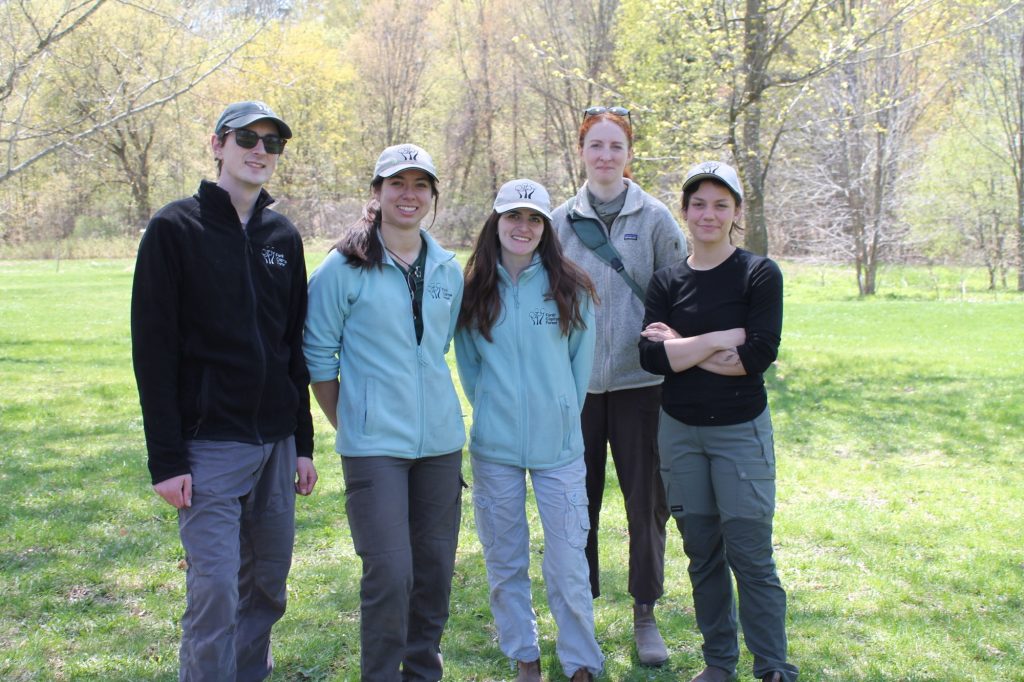
More than 60 volunteers added species, including black maple, white pine and eastern hemlock, as well as shrubs such as elderberry, flowering raspberry and honeysuckle. The goal is not simply to add more trees, but to rebuild the multiple forest layers needed to sustain biodiversity and improve long-term survival.
The effort comes as Ottawa continues to struggle with declining urban tree canopy coverage.
A city tree-equity analysis released in 2025 found that while Ottawa as a whole technically met its 40 per cent canopy target — largely because of rural forests — many urban wards fell well below the benchmark. Fourteen wards lost canopy cover between 2017 and 2022, while the city’s urban canopy declined from 21.5 per cent to 20.6 per cent.
Kitchissippi Ward, where Hampton Park is located, dropped from 27 per cent to 25 per cent over that same period.
William Van Geest, executive director of Ecology Ottawa, said mature urban forests provide critical protection as climate change intensifies.
“We know the critical importance of our tree canopy, and we know the huge benefits that trees offer. Whether it’s cooling – with extreme heat that’s going to be important – or with stormwater absorption – with extreme flooding, that’s super important – and supporting biodiversity,” he said.
Trees and mature forests also play a major role in carbon sequestration, capturing and storing carbon dioxide in trunks, roots and soil. Following COP30 in 2025, the United Nations described forests as “one of the planet’s most powerful tools against climate change.”
For Boddy, preserving forests like Hampton Park means thinking beyond individual street trees.
“Street trees have an average lifespan of 10 years. So unless you’re going to hive off whole areas where you put in a lot more trees as a support network, those trees aren’t going to survive,” she said.
“But it’s not just the tree canopy. We need corridors to support biodiversity to give animals, insects, and birds space to go, which helps the forest network as a whole,” she continued. “A tree on its own is not going to survive. No man is an island, no tree is an island.”
She also noted that forests take decades to develop their carbon-capturing potential fully.
“The problem is a tree doesn’t become mature until it’s at least 40, and most species take the most carbon dioxide when they’re 60 or 70,” said Boddy.
Despite the city’s 40 per cent canopy goal, no timeline has been set to achieve it across all wards — something Van Geest says undermines its credibility.
“There’s no timeline with the 40 per cent canopy target. So, it’s a nice goal, but by when…2050? We don’t know, and they refuse to put a number on it. So it’s hard to take it seriously as a goal,” he said. “We’ve mentioned it multiple times to the council, and no one has corrected us.”