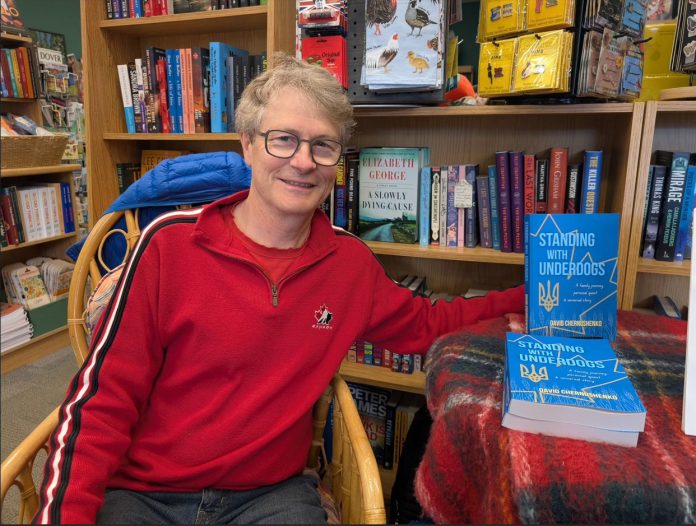

Inside Thyme & Again’s Nest on a grey Sunday afternoon, about 25 people gathered to hear former Ottawa city councillor and environmental advocate David Chernushenko reflect on family history, migration and the long arc of climate action.
The occasion was the launch of his 2025 book, Standing With Underdogs, which traces how his family history has shaped both his personal journey and his public life.
“My book is about how discovering and exploring my Ukrainian roots led me not just to understand where I and my family came from,” he says, “but how the story of the underdog family, the immigrant finding their way in a new world, came to inform my life and my career.”
Drawing on a brief family memoir his Aunt Raya composed in 2021, Chernushenko explores how earlier generations’ experiences of displacement and resilience influenced his own path. Over the years, his individual trajectory has taken him through roles as a Capital Ward city councillor for two terms from 2010 to 2018, as well as a filmmaker, novelist, journalist, and environmental advocate.
A self-described globetrotter, he describes the book as a universal story about starting again.
“People leave where they are when they need something better. When the place they’re at is untenable, dangerous, there are no jobs, and they need something better for their children, they go where they can start a new life.
“That’s the story of human civilizations all over the world, and we often forget that.”
Chernushenko’s interest in underdog stories extends beyond family history and into his decades-long environmental advocacy.
From promoting cycling infrastructure to advancing renewable energy policy, he has worked as a consultant, an advisor to all three levels of government, and a storyteller focused on climate solutions.
The event on March 22 was organized by the Ottawa Renewable Energy Co-operative, which was founded in response to Chernushenko’s 2010 documentary, Powerful: Energy for Everyone.
According to its website, the co-operative has since been “working towards a democratic and clean energy economy in Ontario.” Today, the collective includes about 1,100 members, has raised more than $15 million in local investments, and has completed 33 projects — including 26 solar installations, 2 wind projects, and 5 energy retrofits.
Still, renewable energy faces challenges in a province where nuclear power dominates electricity generation.
Data from the Independent Electricity System Operator featured in the Government of Ontario’s 2024 Energy Snapshot shows that roughly half of the province’s electricity was generated by nuclear sources, while solar represented less than one per cent.
Public opinion reflects similar tensions.
A December poll by Abacus Data found that more than half of Ontarians agreed that Canada could be a global leader in energy and meet its climate goals. However, 48 per cent said they would not support those policies if they harmed the economy, compared with 31 per cent who would and 21 per cent who were unsure.
For Chernushenko, that makes environmental justice an underdog cause.
“The technology is there, the solutions on what we need to do are there,” he says. It’s the programs and policies incentivizing change that are “usually what’s lacking.”
“We need to make it possible and financially advantageous to invest in renewable energy for companies that build the solar panels, the wind turbines and the batteries to do that – to have the incentives to do it, as opposed to continuing to offer the incentives to the most polluting fossil fuel industries.”
Those challenges extend well beyond Canada, he says, including to Ukraine — the country where his family’s story began.
Today, Chernushenko argues that fossil fuels sit at the heart of the war in Ukraine.
“Russia would not be able to fund its war if it didn’t have all of its oil and gas to spend, and didn’t have countries to keep buying it.”
Too often, he says, people think about energy security only in the short term.
Think: “Do I have a heated home? Can I get to work?”
That focus emphasizes whether energy is available when needed, rather than where it comes from or who controls it.
Russia’s ability to maintain geopolitical leverage, he noted, is partly tied to its role as a major global supplier of oil and natural gas. According to the International Energy Agency, Russia is the second-largest producer of natural gas in the world after the United States. Between 2000 and 2023, its crude oil production rose by 66 per cent, and its coal production by 85 per cent.
“Ukraine would be less vulnerable, and could be in the future, the more they can power themselves with renewable energy – be more energy efficient,” Chernushenko says. “Their energy sources would not be as vulnerable to attack from Russia.”
Rather than focusing solely on energy security, he advocates for energy autonomy — generating power closer to home, investing in energy storage systems and maintaining local ownership.
Here in Ottawa, he says that work continues to be shaped by the same roots that inspired his book.
“We are entirely dependent on a healthy ecosystem – we forget that, and I’ve made it part of my life’s project to fight, not just for human justice, but for ecological justice.”