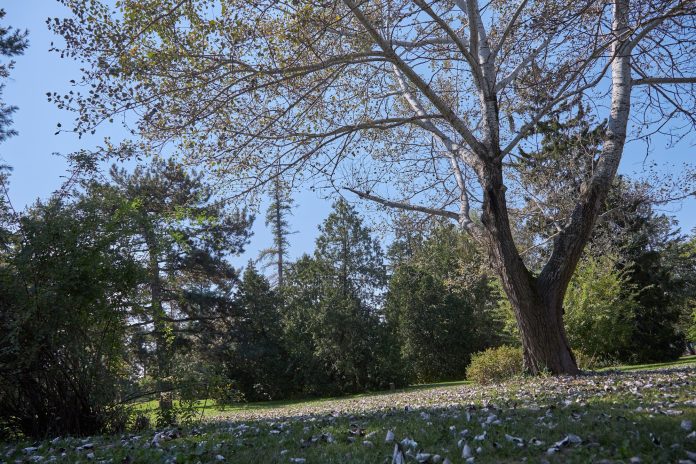

In May 2022, the City of Ottawa and parts of Ontario and Quebec were hit by a powerful weather phenomenon known as a derecho.
With wind gusts of up to 150 kilometres per hour and numerous tornadoes across the region, resulting in weeks-long power outages, and was linked to 15 fatalities. The 2022 derecho is among eastern Canada’s most devastating natural disasters.
Cleanup efforts stretched on for months, with the Insurance Bureau of Canada ranking the storm as the sixth-costliest weather event in Canadian history.
In a statement, Ottawa Hydro said the restoration effort was “so massive in undertaking that it was the equivalent to doing four years’ worth of construction work and emergency repairs in 14 days.”
The statement added that “further complicating matters were the many downed trees, branches tangled in overhead wires and fallen debris in customers’ backyards…”
While the damage to infrastructure and the loss of life were both devastating and widely reported, the impact on urban and rural forests received less attention, compounding what experts say is an already limited understanding of the value of maintaining and restoring tree canopy, particularly in urban areas.
Ottawa contains almost every imaginable style of neighbourhood. From a densely packed urban core, to the suburban landscapes ubiquitous across North America of single dwelling houses and big-box stores, to farmlands on the rural outskirts, Ottawa covers a wide range of environments. Forests, both urban and rural, are an integral part of that landscape.
William van Geest, executive director of Ecology Ottawa, says a healthy tree canopy is critical.
“We know the critical importance of our tree canopy and we know all of the huge benefits that trees offer,” he said.
“Whether it’s cooling – and with extreme heat that’s going to be important – stormwater absorption with extreme flooding that will occur, or whether it’s supporting biodiversity – and we know biodiversity numbers are plummeting.”
Trees Canada, a “national non-profit organization dedicated to planting and nurturing trees in rural and urban environments” lists additional benefits, including food production, reduction of noise pollution, prevention of soil erosion which affects water pollution, and the role trees play as natural carbon sinks that help reduce the greenhouse effect.
Ecology Ottawa has been critical of the City of Ottawa’s efforts to meet its stated goals of 40 per cent tree coverage across the city’s twenty-four wards.
In April of 2019, the City of Ottawa declared a climate emergency and the following year City Council approved the Climate Change Master Plan as a roadmap for the City in addressing and dealing with the realities of climate change.
“The vision of the Climate Change Master Plan is to take unprecedented, collective action that transitions Ottawa to a clean, renewable and resilient city by 2050,” the plan states.
In September of 2025, van Geest addressed the City Council’s Environment and Climate Change Committee following the release of new data on the city’s tree-planting efforts.
The data pointed to a failing in the city’s treeplanting effort. While the five-year period prior showed an overall increase throughout the city from 34 per cent to 36 percent between 2017 and 2022, the findings for a number of individual wards showed considerable decline.
Fourteen Ottawa wards lost tree canopy during that time, with only three wards being above the 40 per cent goal, and the urban area experienced a decline from 21.5 per cent to 20.6 percent.
One of Ecology Ottawa’s recommendations was to include funding for community groups already working to support the plan’s goals, particularly those focused on planting native trees and plants.
“We have repeatedly gone to council to say ‘Accelerate your tree planting strategy,’” van Geest said. “At the the last update on the urban forest management plan, the city itself cited ‘lack of resources’ for why they could only take on one new initiative at a time.”
“And we keep saying, every budget we say ‘Give them more money.’ We know the return on investments for trees is very good – but we’re not seeing that urgency.”
The following month, the city released Climate Ready Ottawa, a five-year action plan beginning in 2026 that outlines how Ottawa will adapt to climate change and build resilience.
One objective of the plan is to “plant, grow, and preserve the urban tree canopy in parks and along roadways, with a focus on neighbourhoods with low tree canopy cover.”
Kitchissippi ward Councillor Jeff Leiper said achieving that goal comes with challenges.
“One of the key challenges – besides the more frequent storms we are seeing that bring trees down, and it will be interesting to see what the effects of this year’s drought will be – but development is also one of the key challenges,” he said.
Leiper said Kitchissippi was historically characterized by single-detached homes on large lots with significant tree cover. Increasing intensification has changed that.
“Single detached homes are demolished and then those are frequently replaced by a lot of severance and [rebuilt with] detached homes that oftentimes have accessory dwelling units in them.”
“We are seeing intensification in respect to the population, but the trees come down in the course of that…and in our ward, the tree canopy has gone down in great part to development.”
Still, he remains optimistic about the city’s broader climate strategy.
“We have intensification goals that ultimately are better for achieving greenhouse gas reductions,” he said, “[and] the reason it’s better for achieving climate change objectives is that when people are to live in 15-minute neighbourhoods, they drive significantly less.”
“So the intensification is having a very hyperlocal effect in terms of tree canopy, but it is good overall for the city’s attempts to achieve climate change objectives.”
Van Geest acknowledged the complexities the city faces, noting that trees face a number of threats.
“Pests and disease are just part of being a tree. And we had the derecho go through, and there are other storms, and certainly there’s always a bit of conflict with power lines – you need to trim a tree or cut it down. That’s the reality of urban trees.”
However, he cautioned against unchecked suburban development.
“The real factor we need to keep our eye on is suburban development,” he said. “The bulldozers [get] on the land and then bulldoze the heck out of it, regardless of what’s there. If there’s a forest, it gets cut down. If there’s a wetland, fill it in.”
Meanwhile, efforts to replace trees lost in the 2022 derecho are still underway in Ottawa.
In July 2023, the Eastern Ontario Derecho Storm Reforestation Program was launched in partnership with the South Nation Conservation Authority.
Aimed primarily at private landowners, the program focuses on restoring damaged woodlots in preparation for tree planting.
The program was recently extended through 2026 – welcome news, advocates say, given the time it takes for trees to mature and the increasing frequency of severe storms.
Tree canopy by municipal ward
In 2017 and 2022, Somerset Ward had the lowest tree canopy in the city at 14 per cent. That was followed by the two Barrhaven wards, Stittsville, and Kanata North, which were all at 20 per cent or lower.
Kitchissippi’s tree canopy was at 27 per cent in 2017, but went down to 25 per cent in 2019. Neighbouring River Ward went from 26 per cent to 25 per cent during the same period.
Results were slightly better in Bay Ward, where the tree canopy has held steady at 35 per cent.
Only College Ward, Rideau Jock, and West Carleton March are at or above the city’s 40 per cent tree canopy threshold.