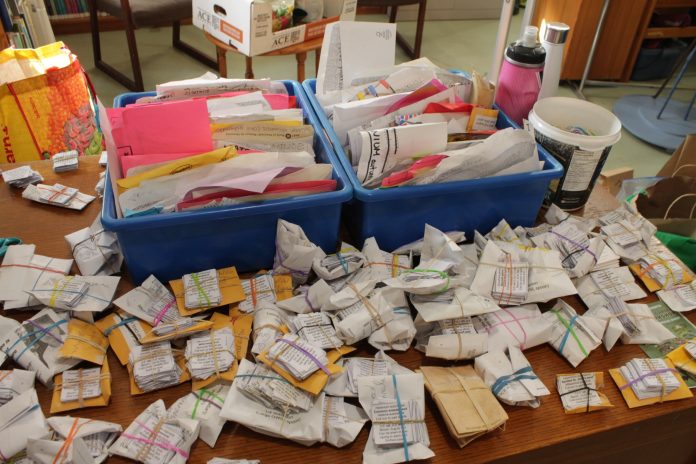

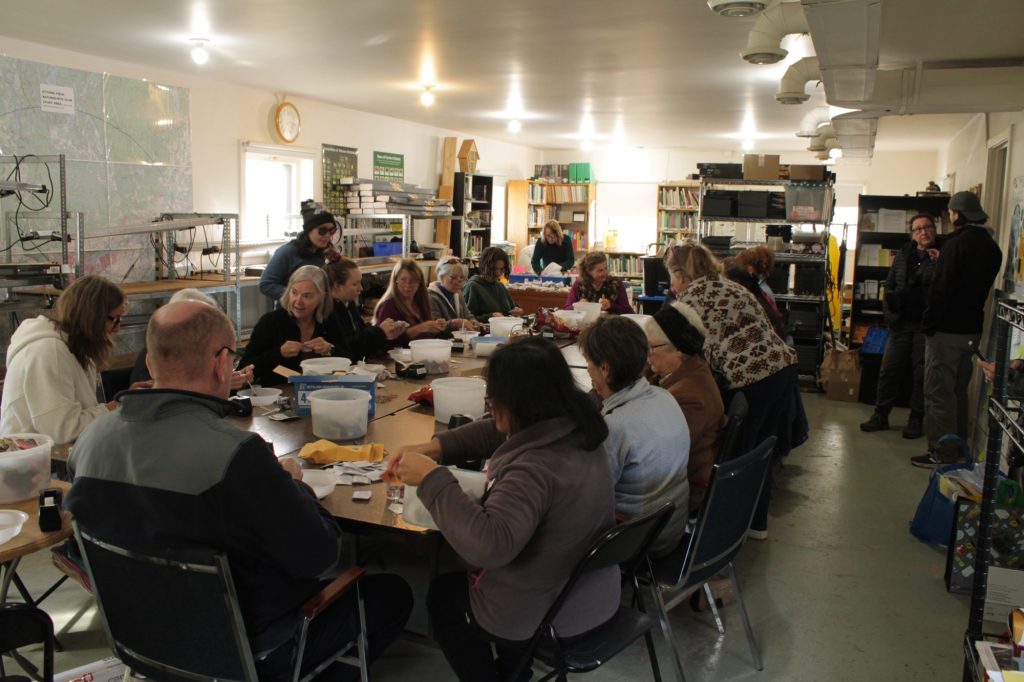
On a chilly Sunday in late October, a group of about 20 volunteers gathered at the Fletcher Wildlife Garden for an afternoon of cleaning and packing native species seeds.
Organized and hosted by the Ottawa Wildflower Seed Library (OWSL), the gathering was part of a series of events taking place during the fall harvest season. A local grassroots organization, OWSL is dedicated to the promotion of native plant gardening.
In October 2020, Mélanie Ouellette, chairperson and founder of OWSL, found herself moved towards social action after watching a YouTube lecture by botanist and author Dr. Robin Wall Kimmerer.
At the end of the lecture, an audience member asked Kimmerer how people could help in a time when “the world is on fire.” Kimmerer answered: “List your talents and follow your passions.”
Ouellette had been searching for ways to volunteer in her local community in a way that aligned with issues she felt passionate about.
“So, that night, that’s basically what I did. I had planted my first native plants in May, and it brought me so much joy to see the impact it was having on the ecosystem. And I wanted to do something for Indigenous reconciliation, and I wanted to work with women and help get them into roles of leadership. I was thinking about all that and had listed the stuff I had done in the past – my background in International Development and an MBA.”
While mulling over these factors, Ouellette came up with the idea of a seed library composed of native wildflower species. While seed libraries are not a new concept, Ouellette hadn’t come across any dedicated exclusively to native species, particularly with a focus on Indigenous practices of matrilineal leadership and environmental stewardship.
After sketching out a plan of action, Ouellette created a Facebook group and webpage in order to share educational resources, then began her search for native species seeds.
“I went on Facebook to gather people that were my early adopters to give me seeds for free. And then I learned how to pack envelopes. Because it was COVID, I mailed them for free to people – like 200 people.
“That’s kind of how I got started. And then as the years progressed, we’re getting more and more people involved, and a lot of people pay it forward. So it keeps growing and growing and growing every year,” she said.
Ouellette said she’s been fortunate to have a friend of Métis heritage advising her on how to observe Indigenous practices of seed harvesting and community.
“He’s been helping me to set up Indigenous principles. And he told me that for Indigenous people, plants and animals are called relatives. All relatives include plants, include animals, and an elder is somebody that knows all the relatives. Our [OWLS’s] education has expanded to include the whole ecosystem so that people know their relatives and know why we need native plants.”
Ouellette also stresses the importance of working with local Indigenous groups.
“We’ve been helping the Kichi Zibi Nation to have native plants and we’ve done winter sowing workshops with them. And we’re also working with them to rename the plants – they have an elder committee that is looking at renaming the plants because the [Indigenous] names have been lost. We’re really trying to foster a local [relationship] because we are living and working on their territory.”
In its fifth anniversary year, OWSL has grown into a thriving network of volunteers, including Lindsay Kuch, who speaks to the value of the community.
“I had recently moved to Ottawa and wanted more plants. As someone living in an urban setting, we don’t always have enough space for all the plants we’d like. So I thought, OK, I’ll get into outside plants, and I showed up to one of their native seed giveaways at Tom Brown Arena last year – November sometime. And it was the most welcoming, supportive community event I think I’d ever been to. Everyone was so warm and friendly and knowledgeable.”
While she packs seeds in the room filled with other volunteers, Kuch describes the changes she’s noticed in herself as a result of her involvement with the group.
“It’s really opened up the world of appreciating nature and biodiversity for me. Because of this I’ve gotten into birding, and now I’m ID’ing a whole bunch of plants and birds. I went back home to see my parents this summer and I’m a completely different person – suddenly I’m into ecology, you know?”
“Appreciation for one species turns into appreciation for many, and you learn about the various bugs and birds that benefit from some of these keystone species,” Kuch said.
Kuch’s experience is reflected in the three pillars, or core values, that the OWSL has laid out as its guideposts.
Listed on the organization’s website they offer a simple yet engaging mandate: to provide free access to seeds, to teach people about gardening responsibly, and to ask seed recipients to reciprocate the gift of nature.
In addition to the pillars, the website details the many offerings that OWSL provides – from seed giveaways to volunteering opportunities, and from instructions on setting up a garden to how to deal with invasive species, the organization shares both education resources and opportunities for involvement.
Every autumn, the OWSL hosts seed giveaways of plants located across the Ottawa region where members of the public can pick up free seed packets filled with a variety of native species – wild bergamot, dense blazing-star, hairy beardtongue and many more.
The species are all detailed in the OWSL’s newly launched seed catalogue. Composed entirely of plants native to Ontario, the seed catalogue adheres to the Database of Vascular Plants of Canada (VASCAN).
Ottawa Wildflower Seed Library Plant Catalogue
At these giveaways, as well at other events throughout the year, OWSL ensures that members are on hand to answer questions and help educate attendees.
“At every seed event we have a wonderful scientist showing you the very easy process of seeds into a pot outside, into the snowbanks of the winter. They’re not for sowing, sprinkling haphazardly, and not for spraying either – putting them into pots over the winter gets you the highest germination,” says board member Bonnie Seguin.
When gathering seeds, OWSL encourages a policy more akin to spot harvesting rather than clear-cutting.
“We have ethical guidelines on how to harvest in the wild. Not more than 10 per cent, don’t take the first or the last one, and [only] harvest when the population is more than 25. These are based on Indigenous principles of honourable harvesting,” says Ouellette.
OWSL also adheres to a policy of using fully native plants, as opposed to cultivars – species that have been bred to enhance or reduce certain traits.
Margate Unger, OWSL Secretary and board member, explains: “Cultivars are when the horticultural industry takes a plant and finds some attribute of it to make it more likeable to humans. There are cultivars that may focus on bringing out a specific colour of the leaves, or they might make a tall plant short.”
“Sometimes insects don’t even recognize (spelling) the plants. Or the double blooms, [the insects] can’t even get into the nectar, into the pollen, because it’s too crowded with petals,” says Unger.
“Or because you focused on particular genetics, that particular set has, maybe, 50 per cent less nectar. And you’re just repeating that, and so you end up with a plant that is completely useless to the beneficial insects that evolved with the plant.”
Experts say maintaining a diverse environment is key to sustainability.
Renate Sangier-Regier, a professor in the University of Ottawa’s Department of Geography, Environment and Geomatics, emphasizes the importance of biodiversity, particularly in environments that are experiencing increasing extremes.
“Native plants tend to have a deep root system, so they can survive dry periods without much help – especially if they get established. There was a study that looked at many different ecosystems to determine which plants are the most important. And they realized that all plants play roles. There are plants that are very common…and then there are other plants that are perhaps not as common. So one might think that they’re not as important, but they play essential roles when it’s really dry or when it’s really wet. So everybody has a role to play.”
The similarities between OWSL’s mandate and nature’s architecture are clear in everything Ouellette shares about the organization, demonstrating that the work the organization does is about both community and plants.
“When I have seed packing events or envelope making events, that’s what I like to see almost as much as packing all those seeds – seeing people meet the stranger and talking with them. And everybody’s very gentle with each other, so meeting the stranger is kind of nice. And I’m proud that we offer those kinds of opportunities.”